
Rotary Lobe Pump vs Gear Pump
Rotary lobe pump vs gear pump: how synchronised non-contacting tri-lobe rotors compare with meshing gear teeth on shear, solids tolerance, pressure, hygiene and the duties each design suits best.
A rotary lobe pump displaces liquid with two synchronised, non-contacting tri-lobe rotors, while a gear pump pushes liquid with meshing gear teeth. The lobe design delivers low-shear, low-pulsation flow for shear-sensitive, viscous and hygienic products, while the gear design is compact, economical and best on clean lubricating oils at higher pressures.
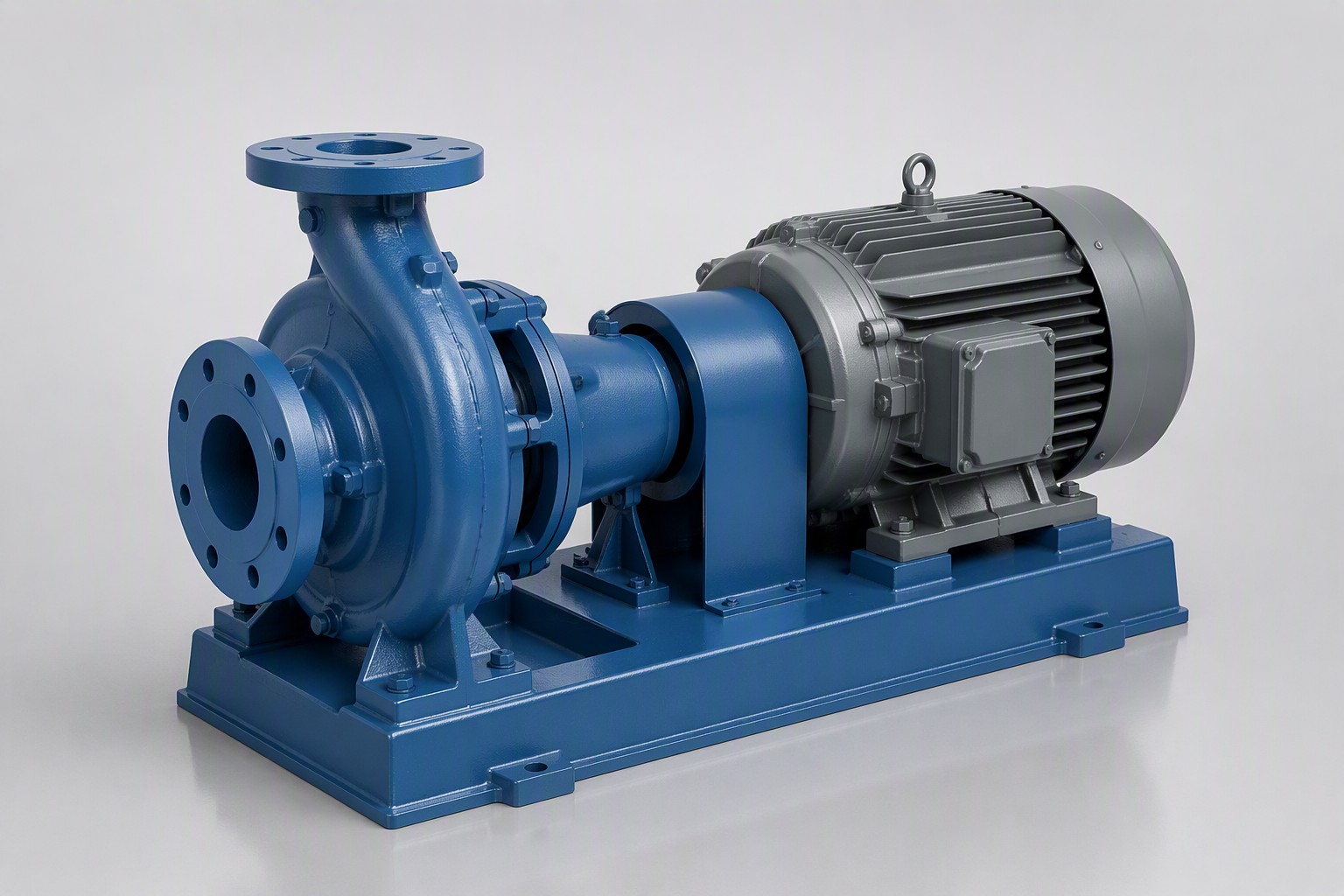
Two Rotary Positive Displacement Designs
Both a rotary lobe pump and a gear pump belong to the positive displacement (PD) family: every shaft revolution traps and moves a nearly fixed volume of liquid, so flow is proportional to speed and stays fairly constant as discharge pressure changes. This is the opposite of a centrifugal pump, where flow falls as head rises and efficiency drops quickly as viscosity climbs.
That fixed-volume behaviour is why both handle viscous media well — above roughly 150 cSt a PD machine usually beats a centrifugal design — and why both self-prime within their vacuum limits. The practical question is not whether they are PD pumps, but how each design seals its moving parts, because that decides which fluids it can pump safely.
How a Rotary Lobe Pump Moves Liquid
A rotary lobe pump uses two tri-lobe rotors that rotate in opposite directions inside a close-fitting casing. Timing gears keep the lobes synchronised so they never touch each other or the casing wall; liquid fills the spaces between the lobes and the casing, is carried from the suction side to the discharge side, and is expelled as each lobe tip passes the outlet (the working principle is covered separately). Design traits that matter here:
- Low shear: liquid is not squeezed between metal surfaces, so emulsions, yoghurt, sauces and polymer latex keep their structure.
- Solids tolerance: the open rotor chambers pass soft solids and particles that would jam or damage a gear set.
- Hygienic build: stainless, crevice-free configurations support cleaning-in-place (CIP) between batches.
- Dry-run behaviour: the rotors are non-contacting, so short dry periods are tolerable in some configurations, seals permitting.
How a Gear Pump Moves Liquid
An external gear pump displaces liquid with two meshing gears inside a close-clearance casing. Liquid fills the tooth spaces, is carried around the outside of the gears, and is forced out where the teeth re-mesh. Because the gear teeth run against each other and are lubricated by the pumped liquid itself, a gear pump needs a clean, lubricating medium — abrasives, water or solids shorten its life quickly.
Internal gear variants with a crescent separator run quieter and with lower pulsation, but the character is the same: tight clearances give compact machines with strong pressure capability on clean oils, at the cost of higher shear and poor dirt tolerance. For clean fuels and lubricating oils a gear pump is often the most economical rotary PD choice.
Rotary Lobe Pump vs Gear Pump at a Glance
Rotary Lobe Pump vs Gear Pump
| Characteristic | Rotary lobe pump | External gear pump |
|---|---|---|
| Displacement mechanism | Synchronised tri-lobe rotors | Meshing gear teeth |
| Rotor contact | Non-contacting (timing gears) | Teeth mesh in the liquid |
| Shear level | Low — gentle on products | Higher at the mesh point |
| Solids tolerance | Moderate — soft solids pass | Poor — clean liquids only |
| Flow pulsation | Low and smooth | Moderate |
| Pressure capability | Moderate pressures | Compact designs reach higher pressures |
| Hygiene and CIP | Hygienic builds clean in place | Limited — internal recesses |
| Typical duty | Food, dairy, cosmetic, polymer, sludge | Fuel, lubricating and heavy oil transfer |
Which Pump Fits Your Duty?
Start with the fluid, not the nameplate. A clean, lubricating oil or fuel at moderate-to-high pressure points to a gear pump: the compact meshing design gives good efficiency and simple maintenance. KCB-style gear pumps and rotary lobe pumps are both technical-reference topics on this site, so confirm current model availability and specifications with Qingdao Green Power before procurement.
If the product is shear-sensitive, food-grade, hygienic or slightly solids-laden, the balance shifts to the lobe pump. Where a duty sits in the grey area between the two technologies — viscous but clean, for example — the engineering guide to high-viscosity pump selection is a useful next step, and a review of the wider industrial pump types keeps the comparison in context.
For reference, Qingdao Green Power's verified ranges confirm the wider picture: IS/ISW centrifugal pumps cover 1.5–1600 m³/h at 2–125 m head for thin fluids, while the G-type single screw pump covers 0.1–150 m³/h at 0.6–2.4 MPa for viscous and abrasive media. On demanding viscous duties a screw pump is a proven alternative to both lobe and gear designs.
Quick Selection Checklist
- Clean oil or fuel at higher pressure: external gear pump.
- Shear-sensitive, hygienic or food product: rotary lobe pump.
- Soft solids present: lobe pump, sized for the required solids passage.
- Dry-running risk: protect the seals and confirm dry-run capability for the specific configuration before buying.
- Model availability: rotary lobe and KCB gear pumps are technical-reference topics — confirm current model availability and specifications with Qingdao Green Power.
Frequently Asked Questions
What is the main difference between a rotary lobe pump and a gear pump?
A rotary lobe pump uses two synchronised, non-contacting tri-lobe rotors driven by timing gears, so the rotors never rub against each other and the pump handles shear-sensitive, viscous and slightly solids-laden fluids gently. A gear pump displaces liquid directly with meshing gear teeth, which suits clean lubricating oils at compact higher pressures but is more sensitive to shear and contamination.
Which pump handles high-viscosity liquids better — a lobe pump or a gear pump?
Both are positive displacement machines and keep their efficiency on viscous media far better than centrifugal pumps, which lose performance above roughly 150 cSt. Choose a lobe pump when the thick liquid is also shear-sensitive, food-grade or contains soft solids; choose a gear pump for clean viscous oils, fuels and lubricants where a compact, economical design at higher pressure matters.
Can a rotary lobe pump run dry?
Because the rotors do not touch each other or the casing, some lobe pump configurations tolerate short dry-running periods, but the shaft seals still need liquid lubrication and continuous dry running will damage them. A gear pump should not run dry at all, since the meshing teeth rely on the pumped liquid for lubrication.
Are rotary lobe pumps and KCB gear pumps current Qingdao Green Power products?
Rotary lobe pumps and KCB gear pumps are treated on this site as technical-reference topics. Confirm current model availability and specifications with Qingdao Green Power before procurement.
Describe your liquid — viscosity, temperature, flow, pressure and solids content — and the engineering team will confirm which pump technology fits your duty and what is currently available.
Get a Quote
Send your fluid data and duty point. Engineers reply within 24 hours.
Contact Us →💬 WhatsApp NowRelated Products
- Industrial Screw Pump
- Centrifugal Pump
Related Articles
How Does a 3RP Lobe Pump Work?
Lobe pump fundamentals
PD vs Centrifugal Pump
Which technology fits?
High-Viscosity Pump Selection
Viscous duty guidance