
How Does a Chemical Pump Work?
Chemical pump working principle explained: how centrifugal chemical pumps convert impeller rotation into pressure, how positive displacement pumps trap and move liquid, and how to tell which principle fits your chemical duty.
A chemical pump works by one of two physical principles: a centrifugal pump spins an impeller that flings liquid outward and converts that velocity into pressure, while a positive displacement pump traps a fixed volume of liquid and pushes it out against the discharge line. The "chemical" label refers to construction — wetted materials, seals and design engineered to contain corrosive or toxic liquids safely. Which principle is right depends mainly on viscosity, required pressure and flow stability.
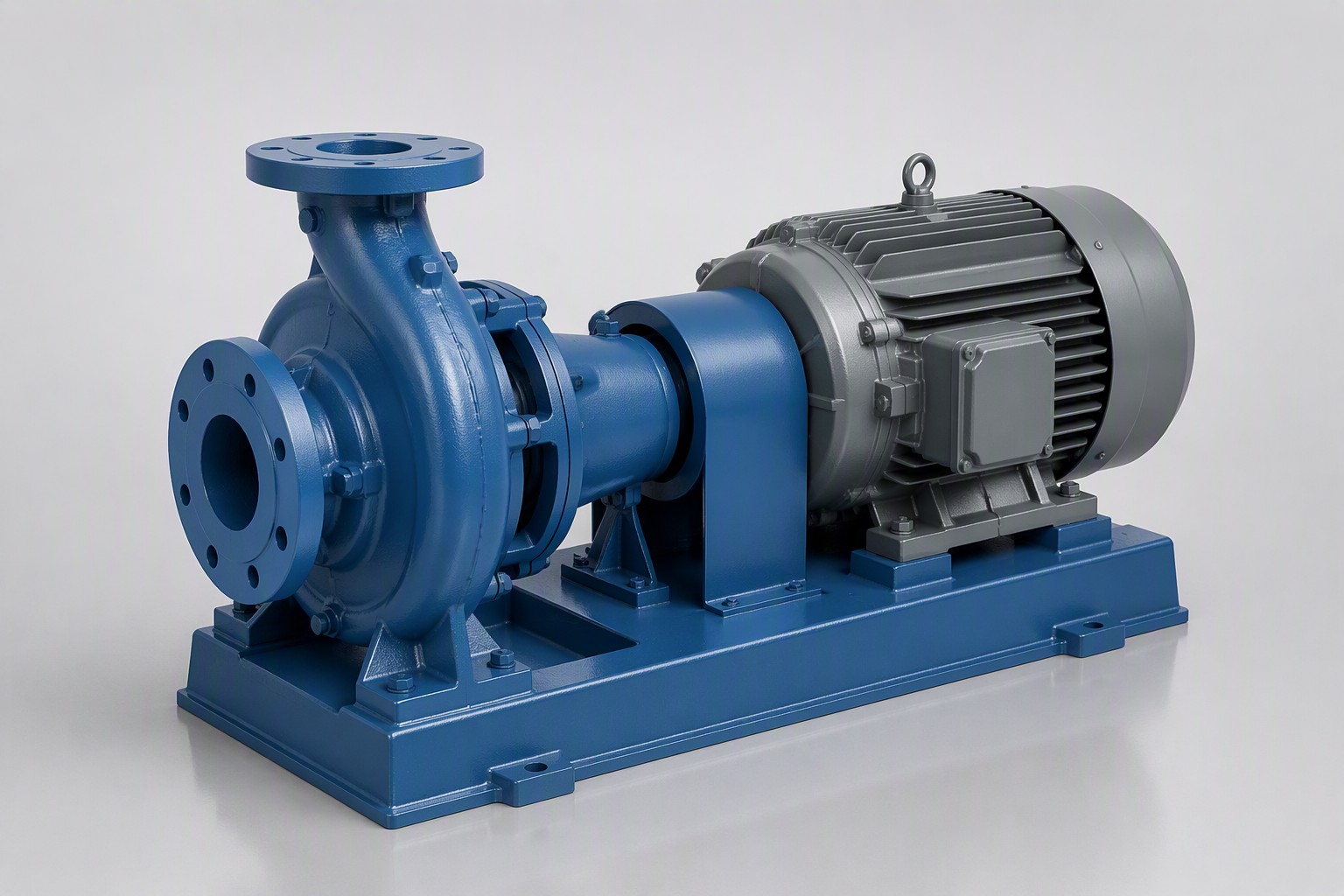
What Is a Chemical Pump?
A chemical pump is a pump whose wetted end — casing, impeller, shaft sleeve and seal — is built to handle corrosive, aggressive or reactive liquids rather than plain water. Two construction families dominate: all-metal machines such as the IH series in SS304 or SS316L for mild chemicals, dilute acids and alkalis up to 80°C, and lined machines such as the IHF series whose PTFE, FEP or PFA lining resists strong acids and oxidising agents up to 100°C. Both belong to Qingdao Green Power's chemical pump range.
The Centrifugal Principle: Speed Becomes Pressure
Centrifugal chemical pumps are the workhorse of the industry for clean, low-to-medium-viscosity liquids. The pump does not trap liquid; it imparts kinetic energy and lets the casing recover it as pressure.
1. Suction — liquid enters the impeller eye
Atmospheric or tank pressure pushes liquid into the low-pressure zone at the impeller centre, called the eye. Hence the need for priming and adequate net positive suction head (NPSH): the pump cannot pull liquid up an empty line.
2. Acceleration — the impeller throws liquid outward
Curved vanes catch the liquid and accelerate it radially outward; the liquid leaves the rim carrying velocity energy proportional to the square of tip speed.
3. Pressure recovery — the volute slows it down
The spiral volute or diffuser widens, slowing the flow and converting kinetic energy into static pressure before discharge. Throttling the discharge valve changes flow; head follows the impeller curve.
The IH and IHF series are published across 3.5–400 m³/h flow and 4.5–125 m head.
The Positive Displacement Principle: Trapped Volume Is Pushed Out
Positive displacement (PD) pumps work differently: rotating or reciprocating elements trap a fixed volume of liquid and displace it into the discharge line each cycle. Flow is proportional to speed and largely independent of discharge pressure, which makes PD pumps the answer for viscous, shear-sensitive or high-pressure duties. In the G-type single screw pump, for example, a helical metal rotor turns inside an elastomeric stator and sealed cavities carry the product smoothly from suction to discharge at 0.1–150 m³/h and 0.6–2.4 MPa. The two technologies are compared in depth in our positive displacement vs centrifugal pump article.
Centrifugal vs Positive Displacement Chemical Pump
| Characteristic | Centrifugal (IH/IHF) | Positive displacement (screw) |
|---|---|---|
| How pressure is made | Impeller velocity converted by volute | Trapped volume pushed against discharge |
| Flow behaviour | Falls as head rises; throttled by valve | Proportional to speed; needs relief valve |
| Viscosity suitability | Low to medium | High viscosity, pastes, slurries |
| Published QGP envelope | 3.5–400 m³/h · 4.5–125 m | 0.1–150 m³/h · 0.6–2.4 MPa |
| Pulsation | Continuous, non-pulsating | Low-pulsation (single screw) |
Gear and lobe pumps apply the same PD idea with different rotors; the choice between them for viscous fluids is explained in our rotary lobe vs gear pump comparison. For very high-viscosity chemicals, start from the high-viscosity pump guidance.
Why the Working Principle Drives Selection
Understanding how the pump makes pressure tells you what will go wrong if you pick the wrong family:
- Viscosity: above roughly 150 cSt a centrifugal pump loses flow and efficiency quickly, so a PD pump becomes practical — see the viscous fluid pump selection guidance.
- Pressure vs head: centrifugals are rated in metres of head and are not built for very high discharge pressures; PD pumps develop pressure and need a relief valve if the discharge can be blocked.
- NPSH and priming: centrifugal pumps need flooded, well-vented suction; PD pumps are self-priming within their vacuum limit but many, such as screw pumps, must never run dry.
Materials and Seals — What Makes It a Chemical Pump
The working principle delivers the hydraulics, but the materials decide whether the pump survives the duty. Wetted parts must resist the chemical at its real concentration and temperature: IH stainless (SS304/316L) covers mild chemicals and dilute acids or alkalis up to 80°C, while IHF fluoroplastic lining extends strong-acid and oxidising service to 100°C. The shaft seal — normally a single or double mechanical seal — is the most likely leak point. Work through the systematic industrial pump selection process with the exact chemical data, and confirm the current model, materials and performance curve with Qingdao Green Power before procurement.
Frequently Asked Questions
What is a chemical pump?
A chemical pump is a pump engineered to handle corrosive, aggressive or reactive liquids. Its wetted materials, seals and configuration are chosen for chemical resistance rather than water service, and it may be either a centrifugal pump or a positive displacement pump depending on the duty.
How does a centrifugal chemical pump create pressure?
A rotating impeller accelerates liquid outward from the suction eye, and the spiral volute casing slows the fast-moving liquid down, converting its velocity energy into static pressure. Flow is throttled by a discharge valve while head follows the impeller curve.
What is the difference between centrifugal and positive displacement chemical pumps?
Centrifugal pumps add velocity and convert it to pressure, suit clean low-viscosity liquids, and lose flow if the discharge is blocked only mildly. Positive displacement pumps trap a fixed volume each cycle and push it out, so flow is proportional to speed, pressure can be high, and a relief valve is required. Qingdao Green Power's IH/IHF centrifugal series covers 3.5–400 m³/h at 4.5–125 m head, and the G-type single screw pump covers 0.1–150 m³/h at 0.6–2.4 MPa.
Why do chemical pumps need special materials and seals?
Because corrosive or toxic liquids would attack ordinary pump metals and leak past ordinary packings. Wetted materials must resist the chemical at its concentration and temperature — IH stainless (SS304/316L) for mild chemicals up to 80°C, IHF PTFE/FEP/PFA linings for strong acids and oxidisers up to 100°C — and single or double mechanical seals contain leakage at the shaft.
Tell us the liquid, viscosity and duty point — the engineering team will confirm the right working principle, materials and configuration for your chemical.
Get a Quote
Send your fluid data and duty point. Engineers reply within 24 hours.
Contact Us →💬 WhatsApp NowRelated Products
- IH/IHF Chemical Pump
- Industrial Screw Pump
- Centrifugal Pump
Related Articles
PD vs Centrifugal Pump
Which technology fits?
What Is an Industrial Pump?
Technology overview
High-Viscosity Pumps
Thick media handling