
How to Choose an Industrial Pump Manufacturer
How to choose an industrial pump manufacturer: specify the duty point and liquid properties, compare verified product ranges, then evaluate engineering depth, quality systems, testing and after-sales support.
To choose an industrial pump manufacturer, first define the duty point and liquid properties, then compare suppliers on product-range coverage, engineering capability, quality systems, testing and after-sales support. A manufacturer that asks for complete duty data — flow, head, viscosity, temperature and NPSH — and explains its selection logic in engineering terms is more likely to deliver a reliable, efficient pump than one that quotes from a model number alone.
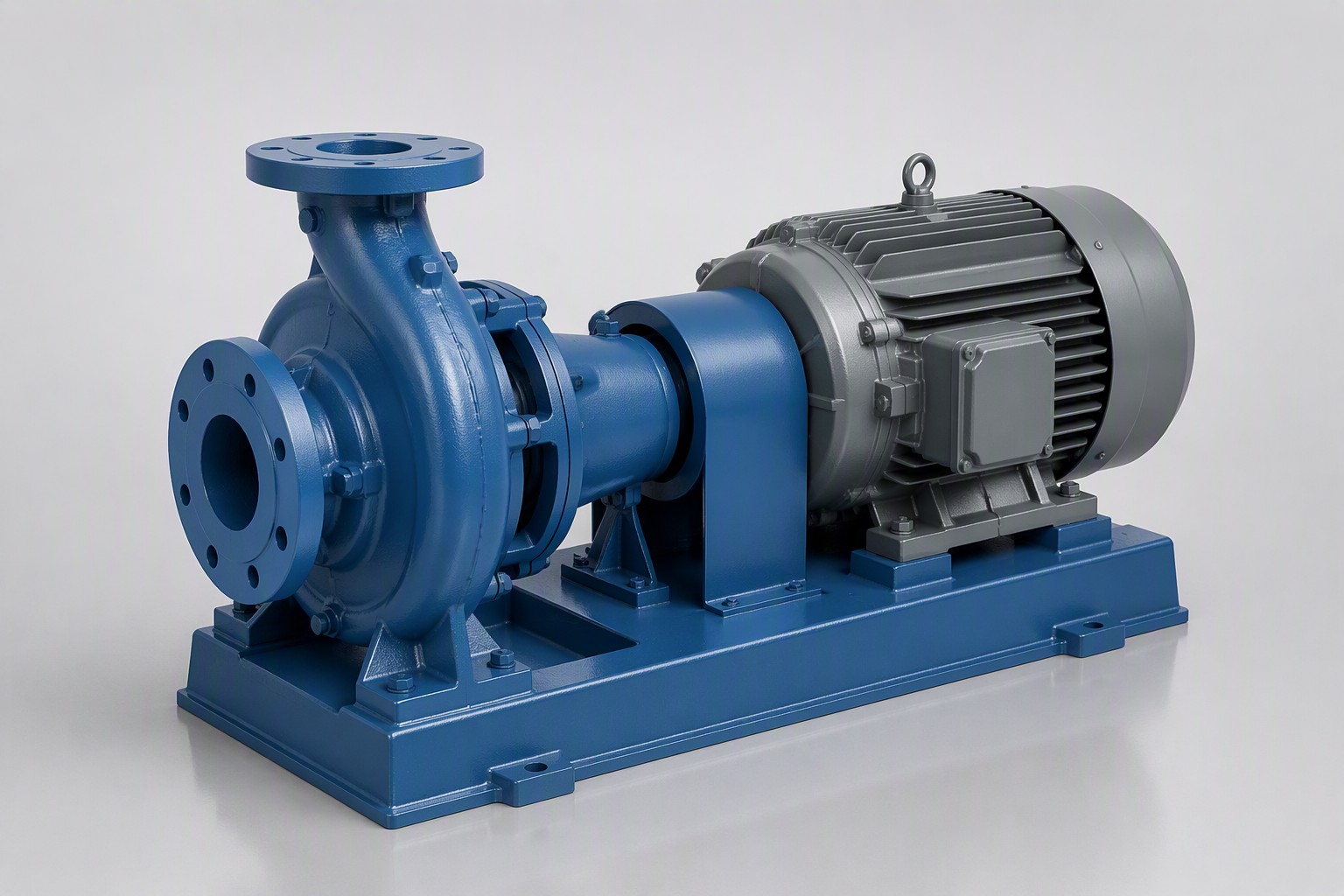
Why the Manufacturer Choice Matters as Much as the Pump
Two suppliers can quote the same nominal pump size and still deliver very different results. The manufacturer sets the quality of the selection engineering, the honesty of the performance data, the advice on wetted materials and seals, and the speed of specialist support after installation. Over a long service life, energy and maintenance usually cost several times the purchase price, so judge a supplier on total cost of ownership rather than first price alone — an industrial pump is a long-lived asset.
Step 1 — Specify the Duty Before You Evaluate Anyone
Every good supplier conversation starts with the duty point. The complete data set is the same regardless of manufacturer:
- Flow rate (m³/h): average and peak values.
- Total head or discharge pressure, including static lift and pipe friction.
- Liquid name and temperature, specific gravity and viscosity.
- Available NPSH at the pump suction.
- Solids, abrasives or shear-sensitive behaviour of the medium.
- Installation layout, motor voltage and enclosure class.
Sending this data does more than improve quotation accuracy: it separates suppliers who work from engineering data from those who work from guesswork. The step-by-step method for turning these inputs into a pump choice is covered in our industrial pump selection guide.
Step 2 — Check the Product Range Against Your Application
A manufacturer's catalogue should cover the technology your duty actually needs. Compare published, verified operating envelopes with your duty point rather than trusting marketing descriptions alone:
Qingdao Green Power Verified Series at a Glance
| Pump family | Typical duty | Published series envelope |
|---|---|---|
| End-suction centrifugal | Water and thin process liquids, ≤80 °C | IS/ISW: 1.5–1600 m³/h, head 2–125 m |
| Chemical centrifugal | Acids, alkalis and oxidising chemicals | IH / IHF: 3.5–400 m³/h, head 4.5–125 m |
| Single-screw (progressive cavity) | Viscous, slurry, shear-sensitive media | G-type: 0.1–150 m³/h, 0.6–2.4 MPa |
| Triple-screw | Low-viscosity oil at high temperature | 3GB: 2.4–241.7 m³/h, up to 350 °C |
| Thermal oil circulation | Heat transfer fluid, -20 °C to 350 °C | RY: 1–500 m³/h, 1–12.5 bar |
| Liquid ring vacuum | Wet gas and condensable vapour | 2BV: 0.45–8.33 m³/min, 0.097 MPa absolute |
If your duty sits inside a published envelope, the supplier can support the recommendation with performance curves and reference installations. If the liquid is above roughly 150 cSt or strongly corrosive, verify how the manufacturer handles the crossover — the articles on positive displacement vs centrifugal pump and viscous fluid pump selection set out the rules a competent supplier should apply.
Step 3 — Look for Engineering Depth and Application Experience
The best catalogue is only as good as the engineer applying it. Ask how the supplier handles the cases where pumps are hardest to choose: high-viscosity fluids, hot media, poor suction conditions, solids and shear-sensitive products. Real application experience shows up in the questions the engineer asks — cold-start viscosity, NPSH margin, seal compatibility — and in the list of similar installations they can point to. Material and sealing competence matters just as much: a chemical duty can fail within weeks if the wetted alloy or lining is wrong, and a leaking thermal-oil line at high temperature is a serious hazard. Verify that the manufacturer can advise on wetted materials, elastomers and seal plans, not only ship a pump.
Step 4 — Verify Quality, Testing and After-Sales Support
A quotation reveals a lot about a manufacturer's quality culture. Look for published performance data, documented test and inspection procedures, and a support policy that matches your operating environment:
- Published performance curves and verified series ranges rather than vague model numbers.
- Material certifications and pressure-test documentation available on request.
- Spare-parts availability and interchangeability of standard components.
- Responsive application engineering before the sale and after commissioning.
- Clear documentation — installation, operation and maintenance manuals in English.
Distance matters less than response quality: most pump problems are solved with the right documents, the right data and an engineer who answers quickly. Test that responsiveness during the quotation phase — it predicts the service you will receive later.
Step 5 — Ask for a Duty-Based Quotation and Compare Like for Like
Finally, request quotations on an identical duty specification and compare like for like: pump family and size, wetted materials, seal type, motor efficiency and total installed power at the operating point. The cheapest first price is rarely the cheapest pump once energy and maintenance are counted over the machine's life. Qingdao Green Power publishes verified ranges across centrifugal, screw, chemical, thermal-oil and vacuum duties — send your duty data and the engineering team will respond with a shortlist and a reasoned recommendation.
Frequently Asked Questions
What should I check when comparing industrial pump manufacturers?
Compare three things: the breadth of the product range relative to your duty, the engineering capability to size and configure the pump correctly, and after-sales support such as documentation, spare parts and response time. A manufacturer that asks for full duty data — flow, head, viscosity, temperature and NPSH — is usually more reliable than one that quotes from a model number alone.
What data does Qingdao Green Power need for a quotation?
Flow rate (m³/h), total head or discharge pressure, liquid name and temperature, specific gravity and viscosity, available NPSH and installation orientation; add motor voltage and enclosure class if you need the full pump package. Qingdao Green Power's engineers use this data to match the duty to the appropriate pump family.
Is Qingdao Green Power a suitable partner if I need several different pump types?
Yes. Qingdao Green Power publishes a broad verified range covering IS/ISW centrifugal pumps (1.5–1600 m³/h, 2–125 m head), IH/IHF chemical pumps (3.5–400 m³/h), G and 3GB screw pumps, RY thermal-oil circulation pumps (1–500 m³/h) and 2BV liquid-ring vacuum pumps (0.45–8.33 m³/min). Confirm current model availability and specifications with Qingdao Green Power before procurement.
How do I know a manufacturer's recommended pump is the right technology for my liquid?
Ask for the reasoning in duty terms. Below roughly 150 cSt a centrifugal pump is usually economical for water-like liquids; above that, viscous, shear-sensitive or slurry media point to screw, gear or lobe machines. A competent supplier explains the viscosity, suction and material logic behind its recommendation instead of pushing a single product family.
Send your duty point and liquid data — the engineering team will recommend the pump family, configuration and series that fits, with a reasoned quotation.
Get a Quote
Send your fluid data and duty point. Engineers reply within 24 hours.
Contact Us →💬 WhatsApp NowRelated Products
- IS/ISW Centrifugal Pump
- G & 3GB Screw Pump
- IH/IHF Chemical Pump
- 2BV Vacuum Pump
Related Articles
What Is an Industrial Pump?
Technology fundamentals
Rotary Lobe vs Gear Pump
Head-to-head comparison
High-Viscosity Pump
Pumping thick fluids