
Centrifugal vs Positive Displacement Pump: How to Choose
Centrifugal vs positive displacement pump comparison: how each technology builds flow and pressure, the viscosity crossover around 150 cSt, and the practical selection path for industrial duties.
Centrifugal and positive displacement pumps move liquid in two fundamentally different ways: a centrifugal pump adds velocity with a spinning impeller and lets the casing convert that velocity into pressure, while a positive displacement (PD) pump traps a fixed volume of liquid and forces it from suction to discharge on each revolution. At fixed speed a centrifugal pump delivers whatever flow the system allows; a PD pump delivers flow that follows speed while pressure rises to match the system. Below about 150 cSt, thin liquids run on centrifugal pumps; above it, choose a gear or screw pump.
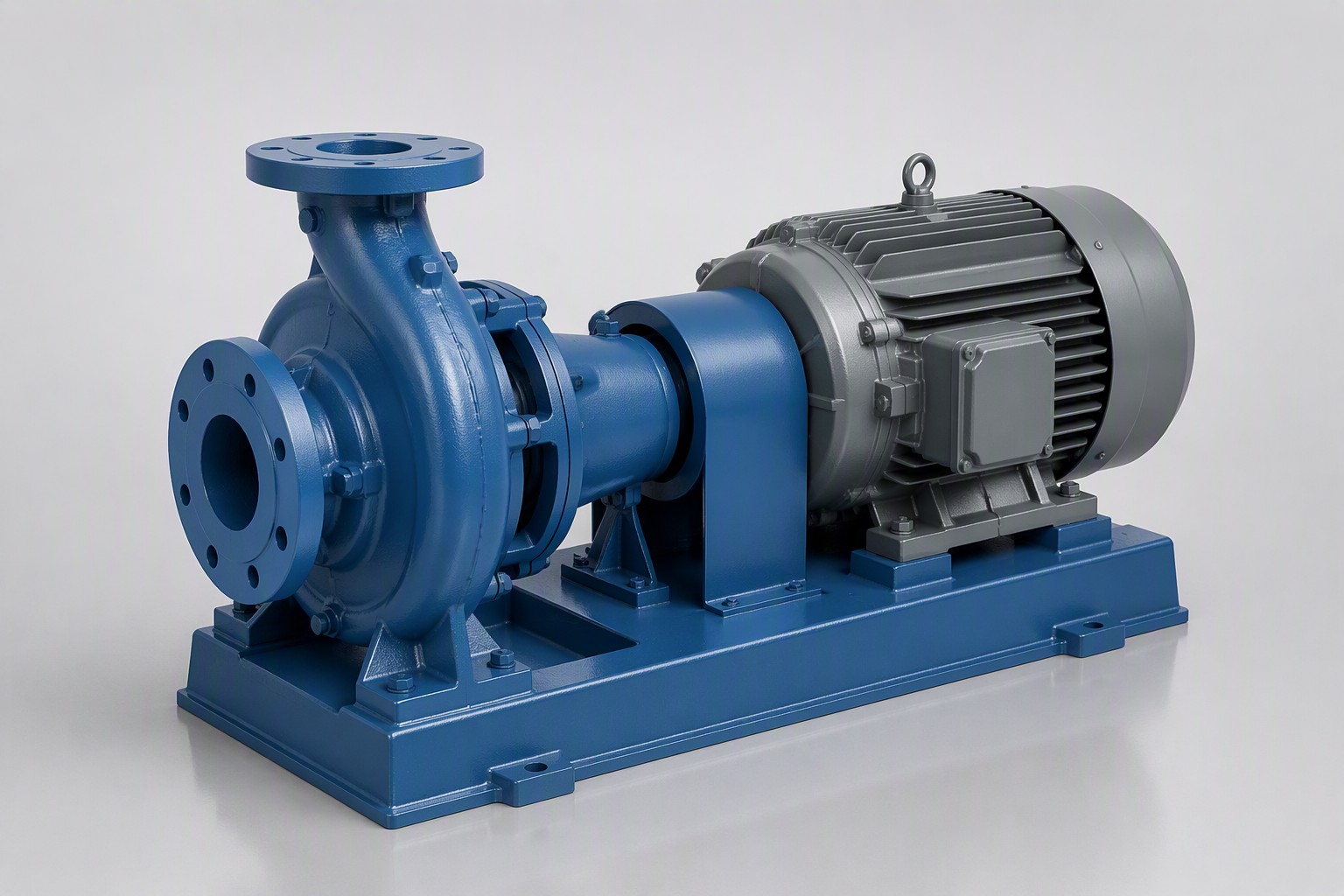
How Each Technology Builds Flow and Pressure
In a centrifugal pump the impeller accelerates the liquid outward; the faster it spins, or the larger the impeller, the higher the head it can generate. At a fixed speed the pump follows its characteristic curve, meeting the system curve of the piping at the operating point. It does not force a set amount of liquid through the system — open a valve and flow rises, close it and flow falls toward shut-off — which is why a centrifugal pump delivers variable flow against a relatively fixed head.
A positive displacement pump, by contrast, displaces nearly the same volume each revolution regardless of discharge pressure, minus a small internal slip. Flow is therefore controlled by speed: a fixed-speed PD pump keeps delivering its displacement volume even as the system resists, so pressure climbs until it balances the system, the driver stalls, or a relief valve opens. That is why PD installations carry a relief valve and PD flow is metered by speed.
Flow, Pressure and Efficiency Characteristics Compared
Centrifugal vs Positive Displacement Pump at a Glance
| Characteristic | Centrifugal pump | Positive displacement pump |
|---|---|---|
| Flow behaviour | Varies with system resistance at fixed speed | Proportional to speed; little changed by pressure |
| Pressure build | Limited by the impeller shut-off head | Rises to the system demand; relief valve required |
| Viscosity handling | Falls off sharply above ~150 cSt | Handles high viscosity; slip falls as viscosity rises |
| Efficiency vs pressure | Peaks near the best-efficiency point | Broad and flat across the pressure range |
| Pulsation | Continuous, non-pulsating | Some types pulse; gear and screw designs are smoother |
| Priming | Needs a flooded or primed suction | Self-priming within its vacuum limit |
Viscosity Is the Decisive Factor
As viscosity climbs, friction inside a centrifugal pump rises steeply: head and flow fall, efficiency collapses and power can climb. The published guidance for the Qingdao Green Power IS/ISW series — 1.5–1600 m³/h at heads of 2–125 m for water and low-viscosity process liquids up to 80°C — states the crossover directly: above about 150 cSt, switch to a gear or screw pump. PD pumps displace volume instead of accelerating it, so heavy oils, resins and syrups are their natural territory; the G-type screw pump is published at 0.1–150 m³/h and 0.6–2.4 MPa. Review fluid properties in pump selection first.
Pulsation, Solids, Shear and Efficiency in Practice
- Efficiency versus pressure: a centrifugal pump is efficient near its best-efficiency point, while a PD pump holds efficiency across a wide pressure band — valuable when the process sets the discharge pressure.
- Pulsation: centrifugal flow is continuous; reciprocating PD pumps pulse, while multi-lobe and screw designs deliver smoother flow.
- Solids handling: open centrifugal impellers pass solids; PD pumps are mostly clean-fluid machines, though lobe and screw types tolerate some.
- Shear sensitivity: a high-speed impeller can damage delicate media; where product integrity matters, low-shear PD types are preferred — see the rotary lobe vs gear pump and screw vs gear pump comparisons.
- Priming: centrifugal pumps need a flooded suction; most PD pumps are self-priming within limits.
Typical Duties: Which Pump Belongs Where
Centrifugal pumps carry the bulk of industrial water duty — transfer, circulation, boosting, cooling water and most thin-liquid chemical services. PD pumps take over when the liquid is viscous, when flow must stay constant while pressure changes, when high discharge pressure is needed at modest flow, or when the pump must lift from a dry suction; gear, screw and lobe pumps then split the duty by viscosity, pressure and product sensitivity.
A Practical Decision Path
Start with the fluid: viscosity, solids content, shear sensitivity and vapour pressure narrow the technology. Then fix the duty — the flow range, the discharge pressure, and whether that pressure changes during operation. If flow must stay constant regardless of back-pressure, or is metered by speed, a PD pump wins; if the plant needs continuous high-flow transfer of a thin liquid, a centrifugal pump is simpler and cheaper.
For water and low-viscosity process liquids, work through the industrial centrifugal pump selection guidance; for oils and other viscous media, confirm the suitable gear, screw or lobe class with the engineering team before procurement.
Frequently Asked Questions
What is the fundamental difference between a centrifugal and a positive displacement pump?
A centrifugal pump adds velocity to the liquid with an impeller, so at fixed speed its flow follows the system resistance and pressure is limited by the impeller head. A positive displacement pump traps a fixed volume per revolution, so flow follows speed while pressure rises until it matches the system demand, bounded by the relief valve and driver power.
At what viscosity should I switch from a centrifugal to a PD pump?
Centrifugal performance degrades as friction losses grow with viscosity. Qingdao Green Power guidance is to switch to a gear or screw pump above about 150 cSt; below that, water and low-viscosity process liquids run efficiently on centrifugal pumps such as the IS/ISW series.
Does a positive displacement pump always deliver constant flow?
Not perfectly. Internal slip — liquid leaking back across internal clearances — rises with pressure and falls as viscosity rises, so real PD flow dips slightly as pressure increases. Flow stays essentially proportional to speed, which is why PD pumps are metered with variable-speed drives.
Why does a positive displacement pump need a relief valve?
Because it keeps displacing its full volume as discharge pressure climbs, a blocked discharge line would make pressure rise until the driver stalls or the piping fails. A relief or protection valve returns liquid to the suction side and caps the pressure.
Tell us the liquid — viscosity, temperature, solids, required flow and pressure — and the engineering team will confirm whether a centrifugal or positive displacement pump fits your duty.
Get a Quote
Send your fluid data and duty point. Engineers reply within 24 hours.
Contact Us →💬 WhatsApp NowRelated Products
- Industrial Centrifugal Pump
Related Articles
Industrial Centrifugal Pump Selection
Selection guide
Pump Selection Fluid Properties
What to check first
Screw Pump vs Gear Pump
PD types compared