
Screw Pump vs Gear Pump
Screw pump vs gear pump compared: progressive cavity and triple screw designs versus meshing gear teeth — viscosity, pressure, temperature, solids handling and the duty each technology fits best.
A screw pump and a gear pump are both rotary positive-displacement machines, but they displace fluid by different mechanisms and suit different fluids. A screw pump conveys liquid along one or more screws — the G-type single screw (progressive cavity) pump for viscous, shear-sensitive, abrasive or sludge media, and the 3GB triple screw pump for low-viscosity oil at high temperature — while a gear pump traps fluid between meshing gear teeth and the casing for clean lubricating oils and fuels. Qingdao Green Power publishes the G-type at 0.1–150 m³/h and 0.6–2.4 MPa and the 3GB at 2.4–241.7 m³/h up to 350°C; gear pump models are confirmed directly with the manufacturer.
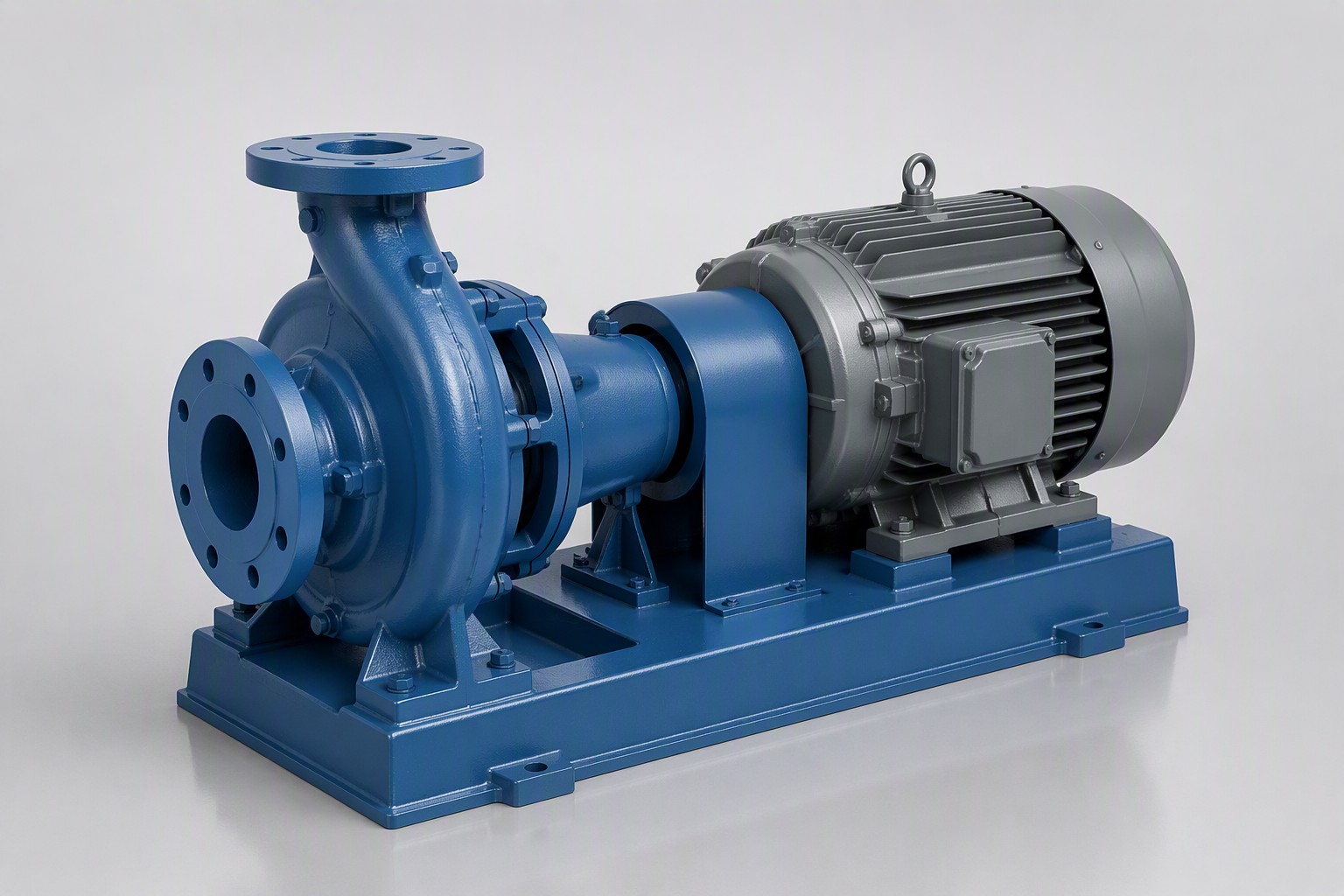
Two Positive-Displacement Designs, Two Mechanisms
Both pumps are rotary positive-displacement (PD) machines: each shaft revolution moves a fixed volume of liquid, so flow tracks speed far more closely than discharge pressure. The similarity ends there — a screw pump conveys fluid along the axis of its screw or screws, while a gear pump carries fluid between meshing gear teeth and the casing. Both outperform centrifugal pumps as viscosity climbs, which is why Qingdao Green Power's published guidance for its IS/ISW centrifugal range is to switch to a gear or screw pump above about 150 cSt. The wider logic is covered in our centrifugal vs positive displacement pump comparison.
How a Screw Pump Works vs a Gear Pump
The G-type single screw pump is a progressive cavity design: a helical metal rotor turns inside an elastomeric stator, forming sealed cavities that travel steadily from suction to discharge. Flow is smooth and nearly pulseless, shear stays low, and the open passages handle media that would destroy a close-clearance pump — Qingdao Green Power lists high-viscosity oils and resins above about 1500 cSt, sludge, slurry, food pastes and shear-sensitive polymers, provided any solids stay below the minimum flow passage dimension. Because the elastomeric stator does the sealing, a G-type pump must never run dry: without liquid the rubber stator is destroyed within seconds.
The 3GB triple screw pump is a multi-screw rotary machine in which three intermeshing screws convey fluid axially. The pumped oil lubricates the screws, so this family is engineered for clean, low-viscosity oil at high temperature — published at 2.4–241.7 m³/h up to 350°C, which suits hot-oil circulation and thermal systems.
A gear pump works differently again. Two meshing gears trap liquid between the teeth and the casing and sweep it from inlet to outlet. Because the teeth themselves seal, clearances are deliberately tight, letting gear pumps reach high differential pressures in a small, economical package on clean lubricating fluids — but the same tight clearances rule out solids, abrasives and deposit-forming fluids.
Screw Pump vs Gear Pump at a Glance
Screw Pump vs Gear Pump — Key Characteristics
| Characteristic | Screw pump (G / 3GB) | Gear pump |
|---|---|---|
| Operating principle | Rotor in stator cavities; or intermeshing screws | Meshing gear teeth and casing |
| Published QGP data | G: 0.1–150 m³/h, 0.6–2.4 MPa; 3GB: 2.4–241.7 m³/h, up to 350°C | Confirm current model availability and specifications with Qingdao Green Power |
| Viscosity window | G: high-viscosity media; 3GB: low-viscosity hot oil | Clean, medium-viscosity oils |
| Solids and abrasives | G tolerates fine solids below the flow passage | Poor — clean fluids only |
| Dry-run tolerance | G: never — stator fails in seconds | Poor — seal damage risk |
| Typical duties | Sludge, slurry, pastes, hot oil | Fuel oil, lubricating oil, hydraulics |
When to Choose a Screw Pump
Choose a screw pump when the fluid is too thick, too abrasive or too temperature-demanding for a gear pump; within the family, the fluid decides the variant:
- G-type single screw — high-viscosity, shear-sensitive or abrasive media, food pastes and polymers, with smooth low-pulsation flow. See the G-type screw pump product range.
- 3GB triple screw — clean low-viscosity oil at high temperature, where the oil itself lubricates the screws; a proven fit for the duties covered in thermal oil pump selection.
When to Choose a Gear Pump
Choose a gear pump when the liquid is a clean, lubricating fluid — fuel oil, lubricating oil, hydraulic oil or similar — and the duty needs a compact, economical machine that reaches higher pressures without a larger PD pump. Gear pumps dominate lubrication and fuel systems on moderately viscous oils; our KCB gear pump selection article explains how to size that alternative for oil duties.
Viscosity, Temperature and Cleanliness Decide
Three questions settle most decisions. Viscosity: above about 150 cSt centrifugal pumps fall away and the choice is between PD types, with G-type screws leading on the very thick end. Temperature: hot, clean, low-viscosity oil points to the 3GB triple screw. Cleanliness: gear pumps reward clean lubricating fluids with compact, high-pressure performance, while solids or abrasives push the duty toward a G-type screw pump. If the product is food-grade and shear-sensitive, a rotary lobe pump is a third PD candidate — see the rotary lobe pump working principle guide. For any model, flow or pressure rating, confirm current model availability and specifications with Qingdao Green Power.
Frequently Asked Questions
What is the main difference between a screw pump and a gear pump?
A screw pump conveys fluid along one or more screws: the G-type single screw (progressive cavity) pump uses a helical rotor inside an elastomeric stator for thick, shear-sensitive or abrasive media, while a 3GB triple screw pump moves low-viscosity oil at high temperature. A gear pump traps fluid between meshing gear teeth and the casing, which suits clean lubricating oils and fuels in a compact package but cannot tolerate solids or abrasives.
Which is better for high-viscosity liquids — a screw pump or a gear pump?
For very thick, shear-sensitive or solids-bearing fluids the G-type single screw pump is the stronger candidate: Qingdao Green Power publishes it at 0.1–150 m³/h and 0.6–2.4 MPa for high-viscosity oils and resins above about 1500 cSt, sludge, slurry and food pastes. A gear pump handles clean medium-viscosity oils economically, but its tight clearances limit it to clean, lubricating fluids.
Can a screw pump run dry?
A G-type single screw pump must never run dry — without liquid its elastomeric stator is destroyed within seconds, so fit low-level protection or a dry-run trip. The 3GB triple screw pump also depends on the pumped oil for lubrication; confirm the operating rules for the selected model with Qingdao Green Power.
What specifications does Qingdao Green Power publish for screw and gear pumps?
For screw pumps, the G-type single screw is published at 0.1–150 m³/h and 0.6–2.4 MPa, and the 3GB triple screw at 2.4–241.7 m³/h for low-viscosity oil up to 350°C. Gear pumps are treated as a technical-reference topic on this site — confirm current model availability and specifications with Qingdao Green Power before procurement.
Unsure whether a screw pump or a gear pump fits your fluid? Send the viscosity, temperature, solids content, flow and pressure — the engineering team will compare both technologies against your duty point.
Get a Quote
Send your fluid data and duty point. Engineers reply within 24 hours.
Contact Us →💬 WhatsApp NowRelated Products
- Industrial Screw Pump (G / 3GB)
- Centrifugal Pump
Related Articles
KCB Gear Pump Selection
Sizing guide for oil duties
Thermal Oil Pump Selection
High-temperature oil systems
Centrifugal vs PD Pump
Technology comparison