
2BV Liquid Ring Vacuum Pump Applications
Liquid ring vacuum pump applications explained: where the 2BV series is used — vacuum filtration, distillation, degassing, paper machine forming and food packaging — and why its wet-gas tolerance wins these duties.
A liquid ring vacuum pump generates vacuum with an eccentrically mounted impeller that spins inside a casing partially filled with sealing water, throwing the water outward to form a moving ring. Gas trapped between the impeller blades and the ring is compressed and expelled each revolution, and because the ring — not close-fitting dry metal parts — does the sealing, wet gas streams, condensable vapours and droplets pass through without damaging the machine. That wet-gas tolerance is why the 2BV series, published at 0.45–8.33 m³/min maximum flow and 0.097 MPa absolute ultimate vacuum, is applied across filtration, distillation, degassing, paper and packaging plants.
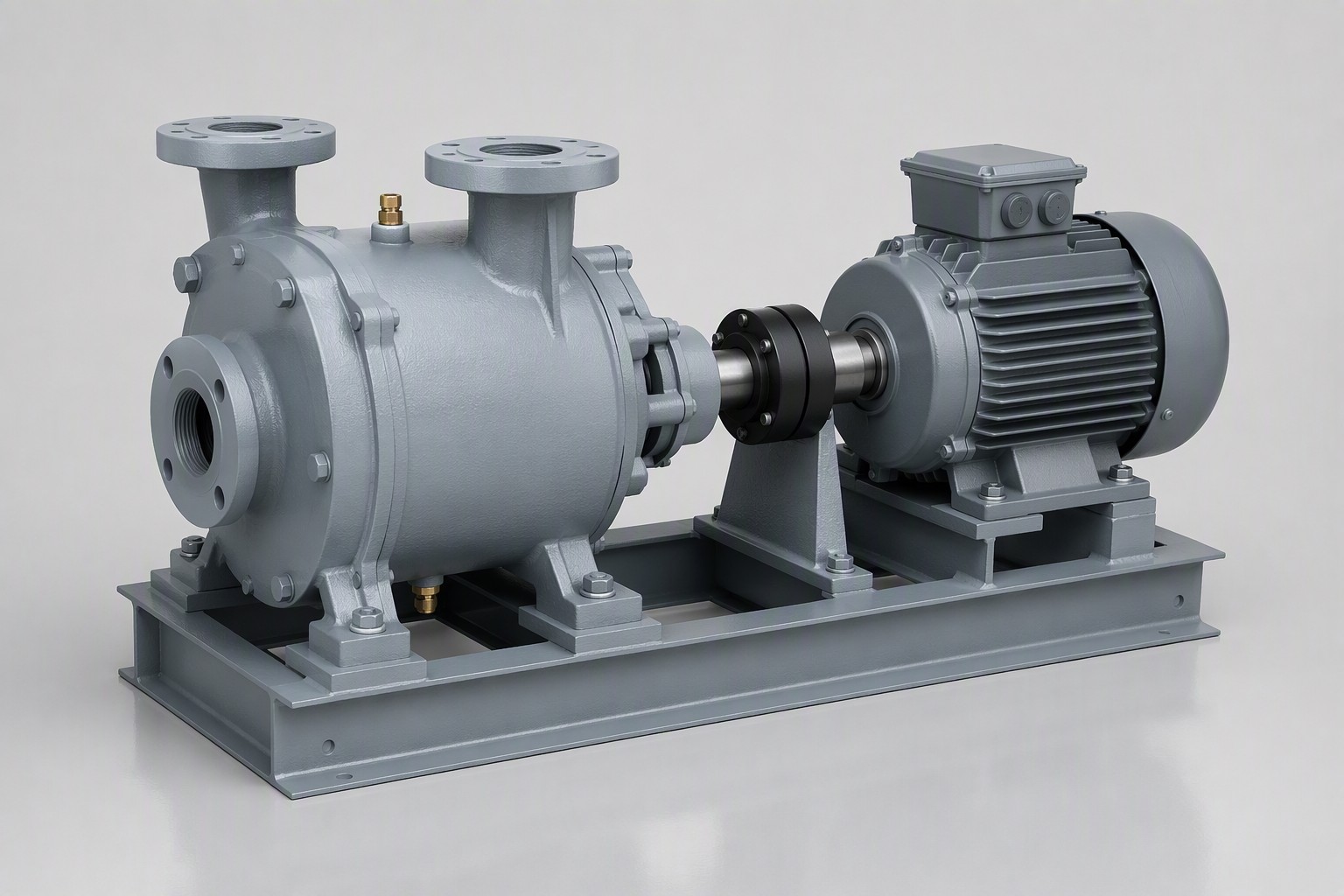
Why the Wet-Gas Advantage Matters in Application
Many vacuum processes pull air together with solvent vapour, water vapour or process moisture, and evaporating, drying and filtering duties routinely condense part of that vapour inside the pump. A dry mechanical vacuum pump must be protected from that liquid, which can wash away lubrication, attack internals or cause seizure; a liquid ring pump absorbs the condensate into the sealing water and carries it away, so wet gas is handled rather than resisted.
Small entrained droplets, foam carry-over and minor particulate are tolerated for the same reason — the liquid ring continuously renews itself — which is why the 2BV vacuum pump is the workhorse of industrial vacuum wherever the gas is never quite clean or dry. Compression is also nearly isothermal because the ring absorbs the heat of compression, useful for temperature-sensitive vapours.
Core Applications of the 2BV Liquid Ring Vacuum Pump
Each application below relies on one capability: stable vacuum with a wet stream at the inlet.
Vacuum filtration and cake dewatering
In a drum, belt or tilting-pan filter, the pump holds a steady vacuum that pulls filtrate through the medium while the cake builds. As the cake thickens and resistance rises, the pump keeps drawing air through the wet filter — a duty hard on dry machines because filtrate vapour and liquid slugs cross the inlet.
Vacuum distillation and solvent recovery
A column under vacuum lowers boiling temperatures so heat-sensitive products can be distilled safely. Solvent vapour that reaches the pump condenses as compression raises pressure and temperature; the liquid ring tolerates that condensable load, which makes the 2BV a standard fit for solvent recovery and for chemical and pharmaceutical vacuum processes where reactors and dryers emit vapour and droplets.
Vacuum degassing and de-aeration
Edible oils, resins, transformer oil and process water are held under vacuum so dissolved gases leave solution and are swept away. Vacuum impregnation uses the same pump to evacuate a chamber before sealant is drawn into porous parts such as motor windings and castings.
Paper machine forming section
On the wet end of a paper machine, vacuum drains and dewaters the sheet on the forming fabric and conditions the felts. The air drawn is humid and fibre-laden — exactly the service a liquid ring pump absorbs without complaint.
Food packaging vacuum
Chamber and modified-atmosphere packaging lines evacuate pouches and trays before sealing, often in humid surroundings with product dust in the air. The water-sealed 2BV keeps working where an oil-sealed or dry pump would not last.
Sealing Water Temperature: The Hidden Control Variable
The achievable vacuum is set less by the impeller than by the sealing-water temperature: warmer water has a higher vapour pressure, which raises the minimum pressure the ring can pull. Rated performance assumes sealing water at or below 30°C; in warm climates or once-through water systems, a heat exchanger or cool make-up supply is usually needed.
Anti-Cavitation Protection Below 80 mbar
As inlet pressure approaches the vapour pressure of the sealing water, the ring flashes locally and the pump cavitates, producing noise, vibration and impeller pitting. For inlet pressures below about 80 mbar — close to the 0.097 MPa absolute ultimate vacuum — fit the manufacturer-recommended anti-cavitation protection pipe, which feeds a controlled gas flow to suppress cavitation.
Published 2BV Series Range
| Parameter | Value |
|---|---|
| Max flow rate | 0.45–8.33 m³/min |
| Ultimate vacuum | 0.097 MPa (absolute) |
| Power | 0.81–15 kW |
| Inlet / outlet | 25–80 mm (1–3 in) |
| Sealing liquid | Water (standard); compatible liquids for special service |
| Sealing water temperature | ≤30°C for rated performance |
| Wet-gas capability | Condensable vapours, droplets and moisture tolerated |
Model selection — flow at the working pressure, sealing-water circuit and wetted materials — follows the duty, and the 2BV liquid ring vacuum pump selection guide walks through that process step by step.
Liquid Ring or Dry Vacuum Technology?
Where the gas is genuinely clean and dry and a deeper vacuum is needed, a dry claw pump competes: it runs oil-free, reaches about 1 mbar absolute and needs no sealing water — but it cannot accept liquids or condensable vapour, the very thing the 2BV handles best. Matching technology to vapour load is the core of industrial vacuum pump selection; where both could work, compare the claw pump against the 2BV package on utility, sealing-water and maintenance costs.
Frequently Asked Questions
Why is a liquid ring pump better than a dry pump for wet gas streams?
The sealing water ring does the sealing and compressing work, so condensable vapours and droplets are absorbed into the water and flushed out continuously. A dry mechanical pump would wash away lubrication, corrode or seize on the same vapour load.
What is the published performance range of the 2BV series?
The 2BV series publishes a maximum flow of 0.45–8.33 m³/min, an ultimate vacuum of 0.097 MPa absolute, power of 0.81–15 kW and inlet/outlet connections of 25–80 mm. Confirm the operating duty point against the selected model performance curve.
Which applications suit a 2BV liquid ring vacuum pump?
Vacuum filtration and cake dewatering, vacuum distillation and solvent recovery, degassing and de-aeration, paper machine forming sections, chemical and pharmaceutical vacuum processes, and food packaging vacuum — wherever wet or condensable vapour is present.
When is anti-cavitation protection required on a 2BV pump?
When the inlet pressure falls below about 80 mbar, the water ring can flash to vapour and the pump cavitates. Fit the manufacturer-recommended anti-cavitation protection pipe and keep the sealing water at or below 30°C for rated performance.
Send your vacuum level, gas composition, vapour load and sealing-water temperature — the engineering team will confirm the right 2BV model, sealing-water arrangement and anti-cavitation accessories.
Get a Quote
Send your process data and duty point. Engineers reply within 24 hours.
Contact Us →💬 WhatsApp NowRelated Products
- 2BV Vacuum Pump
- Claw Pump
Related Articles
2BV Vacuum Pump Selection
Selection guide
Industrial Vacuum Pump Selection
How to choose a vacuum pump
Pumps for Chemical Plants
Chemical industry duties