
How to Choose a Vacuum Pump for Industrial Applications
Industrial vacuum pump selection explained: define the working pressure and gas load, choose between wet liquid ring and dry claw technology, then size the pump and its sealing-water system for the duty.
To choose a vacuum pump for industrial applications, start from the duty: the required working pressure, the volume of gas and vapour to be handled at that pressure, and whether the inlet stream is wet or dry. Liquid ring pumps such as the 2BV series tolerate condensable vapours and droplets and publish 0.45–8.33 m³/min maximum flow at 0.097 MPa absolute ultimate vacuum; dry claw pumps reach about 1 mbar absolute but need clean, dry gas. Match technology and size to that duty.
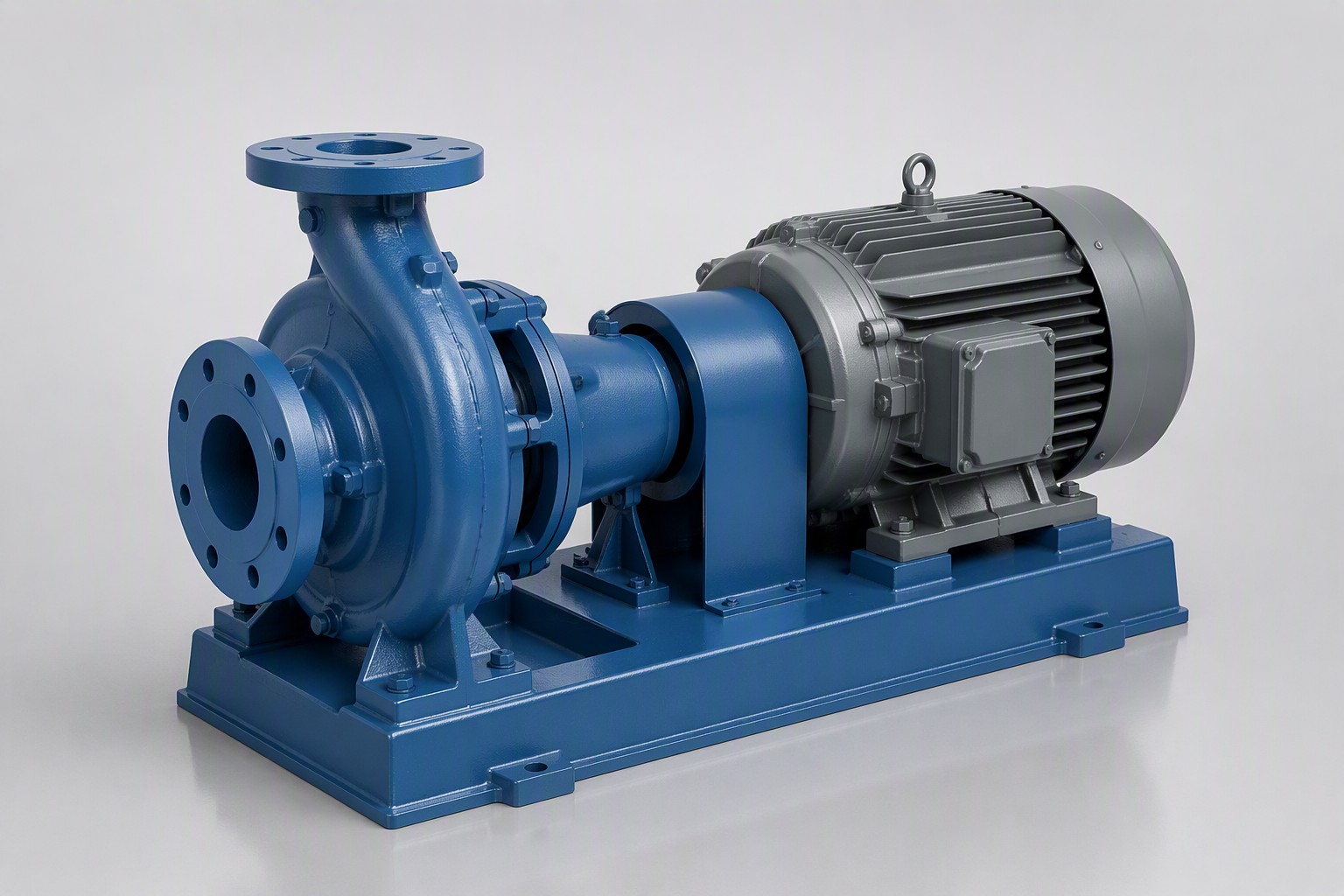
Start With the Duty: Pressure, Gas Load and Composition
First, write down what the vacuum system must do. The working pressure the process needs — in a distillation column, drying chamber or filter vessel — is not the best vacuum the pump can reach. The gas load is air in-leakage plus process gases and vapours, and its composition decides the technology: moisture, solvent vapour, droplets and dust each point to a different family — just as a centrifugal pump suits thin liquids while positive displacement machines handle viscous fluids.
Wet or Dry Service: Choosing the Technology
The decisive question in industrial vacuum pump selection is whether the gas stream is wet or dry. The 2BV liquid ring pump builds its vacuum with a rotating ring of sealing water, so condensable vapour and droplets are absorbed into the ring and flushed out continuously — which makes the 2BV liquid ring vacuum pump range a robust default for filtration, distillation, drying and degassing duties.
Liquid Ring vs Dry Claw at a Glance
| Characteristic | 2BV liquid ring pump | Dry claw pump |
|---|---|---|
| Operating principle | Eccentric impeller + rotating sealing-water ring | Non-contacting claw rotors, dry compression |
| Gas stream tolerated | Wet gas, condensable vapours, droplets | Clean gas, slightly corrosive vapour only |
| Published range | 0.45–8.33 m³/min max flow · 0.097 MPa abs ultimate · 0.81–15 kW | 100–1500 m³/h · ≤1 mbar absolute ultimate |
| Sealing medium | Water at or below 30°C for rated performance | None — oil-free in the gas path |
| Best fit | Wet vacuum processes, vapour recovery | Clean, dry, oil-free vacuum duties |
Where the gas is dry and a deeper vacuum is wanted, a dry claw pump is the cleaner choice: no sealing-water supply or separator, and an oil-free vacuum. The trade-off is that liquids or condensable vapour at the inlet will damage it, as the liquid ring pump application guide explains.
Sizing: Pumping Speed at the Working Pressure
Vacuum pump capacity is quoted as pumping speed and must be read at the working pressure. A pump that moves several cubic metres per minute at atmospheric pressure moves far less near its ultimate vacuum, so always work from the manufacturer's capacity-versus-pressure curve. Size for the average load across the operating range, add margin for in-leakage and pipe losses, and condense vapour upstream where possible.
Sealing Water, Utilities and Operating Cost
For a liquid ring pump the sealing-liquid circuit is a selection item in its own right. Water temperature sets the achievable vacuum, because warmer water has a higher vapour pressure in the ring: keep sealing water at or below 30°C for rated performance and plan the supply circuit — heat exchanger, cool make-up or closed loop — for the site.
Selection Checklist for an Industrial Vacuum Duty
- Define the working vacuum in absolute pressure, against the process rather than the pump's ultimate vacuum.
- Estimate the total gas load — in-leakage, process gas and vapour — and note the condensable fraction.
- Characterise the stream: wet or dry, temperature, corrosives and dust set technology and materials.
- Read the performance curve at the working pressure and size with margin.
- Design auxiliaries: sealing-water temperature and circuit, separator, and anti-cavitation protection below about 80 mbar.
- Compare total cost: power, water, disposal and maintenance across the candidates.
Frequently Asked Questions
What is the first step in choosing an industrial vacuum pump?
Define the duty: the required working pressure, the gas and vapour load at the inlet, and whether the stream is wet or dry. Technology choice — liquid ring, dry claw or another type — follows from that duty, not from pipe size or motor frame.
What is the difference between ultimate vacuum and working vacuum?
Ultimate vacuum is the lowest pressure the pump can reach with the inlet blanked off, and it is never a good operating point. Size the pump on the working pressure and on the pumping speed needed there, including air in-leakage and process out-gassing.
Which published ranges does Qingdao Green Power offer for industrial vacuum pumps?
The 2BV liquid ring series publishes 0.45–8.33 m³/min max flow, 0.097 MPa absolute ultimate vacuum and 0.81–15 kW motor power, with sealing water at or below 30°C for rated performance; the dry claw range publishes about 1 mbar absolute at 100–1500 m³/h. Confirm the duty point against the selected model's performance curve.
When should I choose a dry claw pump instead of a liquid ring pump?
Choose a dry claw pump when the gas is clean and dry, oil-free vacuum is required and sealing-water supply or disposal is a problem. Choose a liquid ring pump when the stream carries condensable vapour, droplets or moisture, which would damage a dry machine.
Send your vacuum level, gas and vapour load, stream composition and sealing-water conditions — the engineering team will confirm the right vacuum pump technology and package.
Get a Quote
Send your vacuum duty and gas composition. Engineers reply within 24 hours.
Contact Us →💬 WhatsApp NowRelated Products
- 2BV Vacuum Pump
- Industrial Screw Pump
Related Articles
2BV Liquid Ring Applications
Application guide
2BV Vacuum Pump Selection
Step-by-step guide
Centrifugal vs PD Pumps
Which technology fits?