
How to Choose an Industrial Centrifugal Pump
How to choose an industrial centrifugal pump: fix the duty point, stay inside the viscosity and temperature envelope of the IS/ISW series, then check NPSH, seals, materials and installation layout before you buy.
Choose an industrial centrifugal pump by matching its flow and head envelope to a thin, low-viscosity liquid. Qingdao Green Power's IS/ISW centrifugal pumps are published at 1.5–1600 m³/h flow, 2–125 m head and liquid temperatures up to 80 °C, which suits water and most process liquids. The practical viscosity limit sits near 150 cSt: above that level centrifugal efficiency collapses and a gear or screw pump becomes the correct technology.
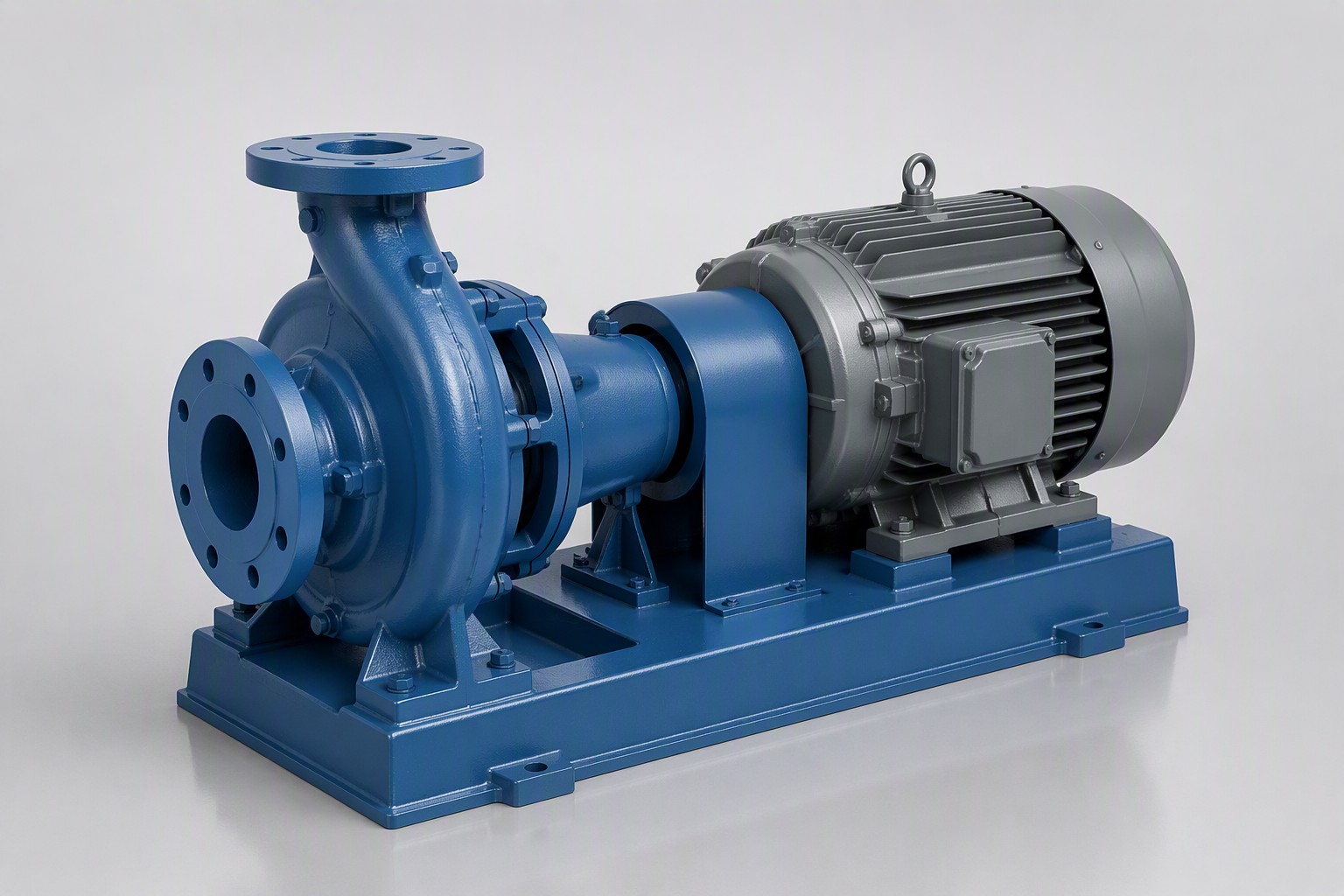
What an Industrial Centrifugal Pump Is For
A centrifugal pump transfers energy from a rotating impeller into the liquid: fluid enters the impeller eye, is accelerated outward, and its velocity is converted into pressure in the volute casing. The result is smooth, continuous, non-pulsating flow, which is why centrifugal machines dominate water supply, cooling circuits and most low-viscosity process transfer. For a clean, thin liquid below about 80 °C, an end-suction or inline centrifugal pump is normally the most economical choice.
Step 1: Confirm the Liquid Suits a Centrifugal Pump
The first filter is viscosity. Centrifugal pumps move water-like liquids efficiently, but viscous drag multiplies friction losses inside the casing, so efficiency falls quickly as the fluid thickens. Above roughly 150 cSt the advantage disappears and a positive displacement machine should take over, as explained in our comparison of centrifugal versus positive displacement pumps. Qingdao Green Power publishes its IS/ISW range for water and low-viscosity process liquids at 1.5–1600 m³/h, 2–125 m head and up to 80 °C. Higher-viscosity duties are served by the G-type single-screw pump in the industrial screw pump range.
Step 2: Define the Duty Point
Before comparing models, fix the duty point with the same data set Qingdao Green Power uses to build quotations:
- Flow rate — average and maximum duty in m³/h, including future margin.
- Total head — total dynamic head in metres, or discharge pressure, at the worst condition.
- Liquid properties — name, temperature, specific gravity, viscosity and any solids.
- Available NPSH — suction head at the pump flange, checked at the worst case.
- Site data — motor voltage, frequency, IP class and installation orientation.
Step 3: Compare the Configuration That Fits the Plant
The IS/ISW family covers both common layouts. A horizontal end-suction configuration sits on a baseplate beside the tank or process; a horizontal inline configuration mounts directly in the pipe run, saving floor space where flanges can be aligned. Both share the published family envelope, and the centrifugal pump product page shows how the series differ by duty:
Qingdao Green Power IS/ISW Centrifugal Pump — Published Envelope
| Parameter | IS/ISW series value |
|---|---|
| Flow rate | 1.5–1600 m³/h |
| Total head | 2–125 m |
| Motor power | 0.18–250 kW |
| Liquid temperature | Up to 80 °C |
| Suitable liquids | Water and low-viscosity process liquids |
| Practical viscosity limit | About 150 cSt — above this use a gear or screw pump |
Where one stage cannot reach the required head, multistage versions stack impellers for high-pressure boosting, and self-priming and solids-handling variants extend the same principle to harder services. Review the full industrial centrifugal pump range and confirm current model availability with Qingdao Green Power before finalising the shortlist.
Step 4: Check NPSH, Seals and Materials
Available NPSH at the suction flange must exceed the pump's required NPSH with a safety margin, or the impeller will cavitate; long suction lines, strainers, hot liquid and low tank levels all reduce the available value. Seals follow the liquid: a single mechanical seal suits clean water, while double seals or flush plans protect aggressive duties. Wetted materials must resist the liquid, and the motor must match the site voltage and protection class. For hot heat-transfer fluids, look to the dedicated thermal oil circulation pump line instead of a standard IS/ISW machine.
Step 5: Know the Special-Service Relatives
Industrial centrifugal pump selection rarely ends at the pump itself. When the medium is viscous, screw or gear pumps replace centrifugals — the screw pump range covers this territory. When the liquid is thermal oil at high temperature, thermal oil pumps have their own cooling and sealing rules, explained in the thermal oil pump selection article. And if the real requirement is vacuum, a liquid ring pump is a different animal — see our liquid ring vacuum pump applications guide. Each family has its own selection logic, and mixing them up is a common sourcing error.
Frequently Asked Questions
What is the difference between a centrifugal pump and a positive displacement pump?
A centrifugal pump accelerates liquid with a rotating impeller and converts velocity into pressure, so flow is continuous and non-pulsating but falls as discharge pressure rises. A positive displacement pump traps a fixed volume each revolution, so flow stays steadier against pressure and viscous fluids are handled better. Centrifugal machines fit water and thin process liquids; above about 150 cSt a gear or screw pump is usually the better technology.
What data is needed to select an industrial centrifugal pump?
Flow rate in m³/h, total head in metres or discharge pressure, the liquid name and temperature, specific gravity and viscosity, available NPSH, motor voltage and IP class, and the installation orientation. Qingdao Green Power uses exactly this data set to build a quotation.
What are the published limits of the Qingdao Green Power IS/ISW range?
The IS/ISW centrifugal series is published at 1.5–1600 m³/h flow, 2–125 m head, 0.18–250 kW motor power and liquid temperatures up to 80 °C, sized for water and low-viscosity process liquids. Confirm current model availability and specifications with Qingdao Green Power before procurement.
Why does viscosity decide between a centrifugal and a screw pump?
Because viscous drag multiplies friction losses inside a centrifugal casing, efficiency collapses as viscosity climbs. Above roughly 150 cSt the produced flow and head fall steeply, so a positive displacement machine is preferred — Qingdao Green Power's G-type single-screw pump is published at 0.1–150 m³/h and 0.6–2.4 MPa for high-viscosity media.
Send your duty point — liquid, flow, head, temperature and viscosity — and the engineering team will recommend the right centrifugal series, or flag when positive displacement is the better route.
Get a Quote
Send your fluid data and duty point. Engineers reply within 24 hours.
Contact Us →💬 WhatsApp NowRelated Products
- IS/ISW Centrifugal Pump
- Industrial Screw Pump
Related Articles
Centrifugal vs Positive Displacement
Which technology fits?
Thermal Oil Pump Selection
Hot heat-transfer-fluid duty
Liquid Ring Vacuum Applications
When the duty is vacuum