
Polymer Transfer Pump Selection Guide
Polymer transfer pump selection guide: how to choose between screw and centrifugal pumps for viscous, shear-sensitive resins, adhesives, latexes and polymer solutions — with the duty data that decides the choice.
Selecting a polymer transfer pump means matching a positive displacement machine to a viscous, shear-sensitive and often non-Newtonian liquid whose viscosity changes with shear rate and temperature. The safest general choice is the G-type single screw (progressive cavity) pump — Qingdao Green Power publishes it at 0.1–150 m³/h and 0.6–2.4 MPa for oils, resins and polymers above about 1500 cSt — while dilute polymer solutions below about 150 cSt can still be handled by an IS/ISW centrifugal pump. The selected pump must never run dry and needs over-pressure protection.
Why Polymer Transfer Is a Specialist Duty
Polymers are long-chain molecules, and that chemistry dictates the pumping rules. Many polymer liquids are non-Newtonian: apparent viscosity falls as shear rate rises, so a fluid can look thin in a fast impeller yet stay thick in a pipe. High shear also breaks polymer chains and lowers product quality, so the pump must move the liquid with low, controlled shear rather than high rotor speed or violent impeller action.
Temperature matters as much as shear. Resins, hot-melt adhesives and polymer melts are often pumped just above their softening point, where a small temperature drop thickens the liquid sharply. Polymer transfer therefore belongs to the wider problem of moving thick fluids, ranked in our guide to the best pump for high-viscosity liquids.
Define the Polymer and the Duty First
Before any pump is sized, collect the data that decide the technology:
- Viscosity profile: at operating temperature and at the coldest credible start — one number is never enough for a polymer.
- Rheology: shear-thinning or thixotropic behaviour, and how much shear the product tolerates.
- Solids and fillers: pigments, carbon black or mineral fillers make the fluid abrasive and raise rotor and stator wear.
- Chemistry and temperature: monomers, solvents and curing agents attack elastomers and seals; temperature defines the material and heating limits.
- Flow and pressure: average and peak flow, discharge pressure, and continuous or batch transfer.
- Suction conditions: flooded inlet or lift, available NPSH and inlet piping length.
Guidance on the extreme end of the spectrum is covered in the article on how to pump extremely viscous fluids.
Pump Options for Polymer Transfer
G-type single screw (progressive cavity) pump
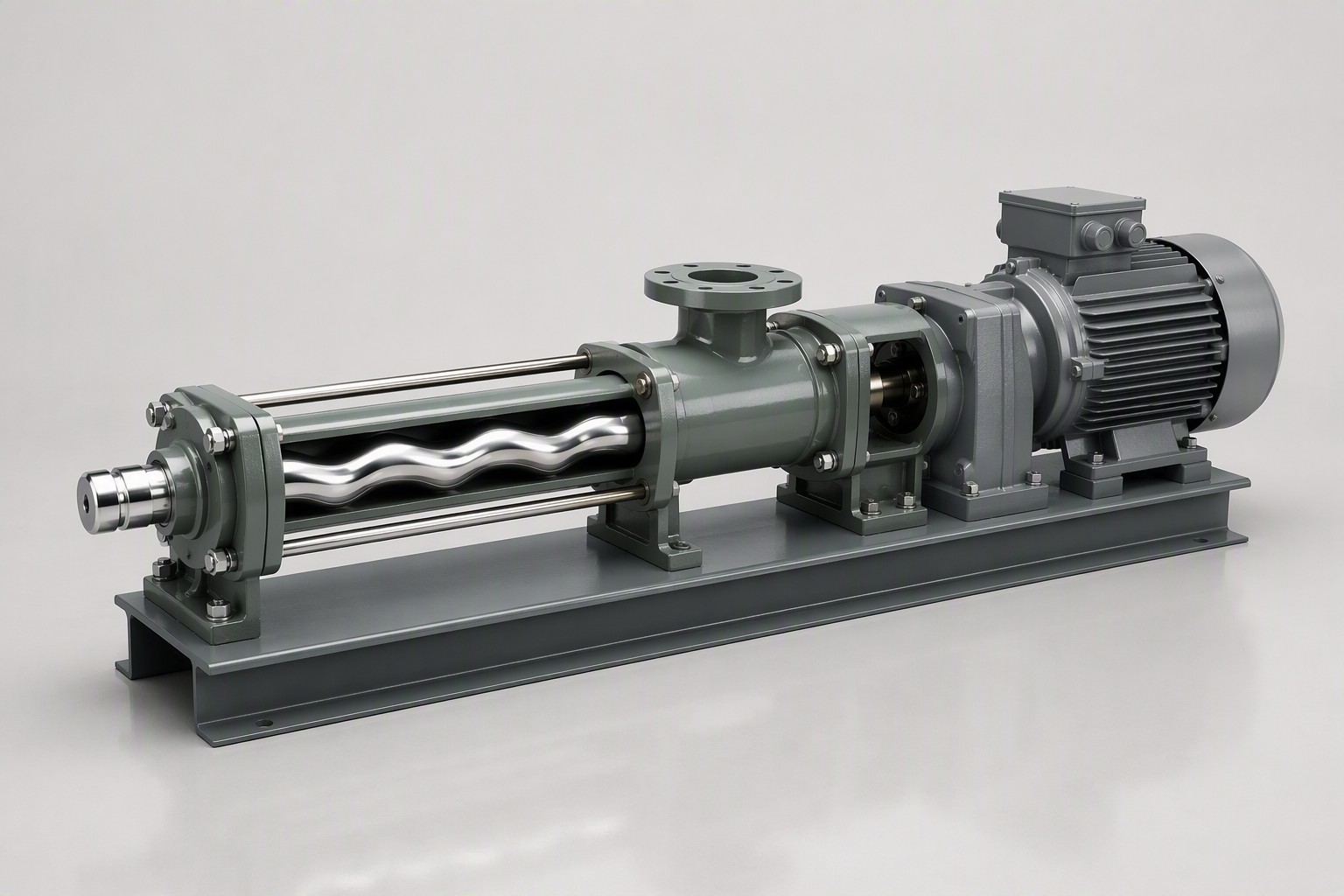
For finished polymers — viscous resins, adhesives, latex concentrates and filled compounds — the progressive cavity pump is the standard workhorse. A helical stainless rotor turns inside an elastomeric stator, and sealed cavities advance the liquid with low shear and a steady, low-pulsation flow. Qingdao Green Power publishes the G-type at 0.1–150 m³/h and 0.6–2.4 MPa for oils and resins above about 1500 cSt, with stator grades (NBR, EPDM or FKM) matched to the chemistry. One rule overrides everything else: never run the pump dry — the rubber stator is destroyed within seconds without liquid.
Triple screw and centrifugal options
The 3GB triple screw pump (2.4–241.7 m³/h, up to 350°C) suits clean, low-viscosity fluids at high temperature, relevant where a polymer stream is kept hot enough to stay thin; because the pumped liquid lubricates the screws, the medium must stay clean and non-abrasive. At the other end of the scale, dilute solutions, emulsions and latexes below about 150 cSt can still use an IS/ISW centrifugal pump. Both screw-pump families are detailed on the G and 3GB industrial screw pump page; extrusion and melt-metering lines additionally use gear-type melt pumps, which are compact and precise at high pressure but tolerate only clean polymer.
Polymer Transfer Technology at a Glance
| Characteristic | G single screw (progressive cavity) | 3GB triple screw | Centrifugal (IS / ISW) |
|---|---|---|---|
| Operating principle | Helical rotor in elastomeric stator | Three intermeshing screws | Impeller velocity energy |
| Published flow | 0.1–150 m³/h | 2.4–241.7 m³/h | 1.5–1600 m³/h (below about 150 cSt) |
| Pressure / temperature | 0.6–2.4 MPa; media-dependent | Up to 350°C | To 80°C typical |
| Shear level | Low — gentle on polymer chains | Low-moderate, clean fluids only | High — degrades viscous polymer |
| Dry-run tolerance | None — stator fails in seconds | Poor | Poor for seal |
| Typical polymer duty | Resins, adhesives, latex, filled compounds above 1500 cSt | Clean hot low-viscosity polymer fluids — confirm suitability | Dilute solutions and emulsions |
System Checks That Decide Pump Life
- Feed the suction properly: viscous polymers create high inlet friction — keep the suction short, large-bore and flooded, with enough NPSH margin.
- Run at controlled speed: in progressive cavity pumps speed sets both flow and shear, so select size and gear ratio for slow, product-safe running.
- Protect against dry running: fit level control or dry-run protection; the stator of a G-type pump is destroyed within seconds without liquid.
- Add relief protection: a blocked discharge must not overload the drive or burst the line.
- Match elastomers and materials: confirm the stator grade and wetted materials against the monomers, solvents and temperature in the recipe.
- Plan heating and flushing: jacketed lines and pumps keep melts fluid; flushing prevents reactive resin from curing inside the machine between batches.
The same logic transfers to other demanding media — see heavy oil pump selection, high-viscosity oil transfer and bitumen and asphalt transfer.
Frequently Asked Questions
What is the best type of pump for transferring polymer?
For viscous, shear-sensitive polymers the G-type single screw (progressive cavity) pump is the primary choice — Qingdao Green Power publishes it at 0.1–150 m³/h and 0.6–2.4 MPa for media above about 1500 cSt. Clean, low-viscosity polymer solutions can use an IS/ISW centrifugal pump below about 150 cSt, and hot-melt metering lines typically use gear-type melt pumps; confirm the right family and model with Qingdao Green Power for your duty.
Can I use a centrifugal pump for polymer transfer?
Only for dilute, free-flowing polymer solutions, emulsions and latexes. Qingdao Green Power's published guidance for its IS/ISW centrifugal range is to switch to a gear or screw pump above about 150 cSt, and most finished polymer melts and resins sit far above that limit, where impeller shear also degrades the polymer chains.
Why must a progressive cavity pump never run dry?
The elastomeric stator of a G-type single screw pump is destroyed within seconds when the pump runs without liquid, because the rotor generates friction and heat with no pumped medium to lubricate and cool the rubber. Dry-run protection, a flooded suction and a never-empty feed are mandatory in polymer service.
What data are needed to select a polymer transfer pump?
You need the viscosity profile at operating and cold-start temperature, shear behaviour and shear tolerance, chemistry, solids or filler content, required flow, discharge pressure, suction conditions and temperature range. Send these to Qingdao Green Power so the pump size, speed, stator elastomer and wetted materials can be confirmed against your polymer duty.
Send the polymer data — viscosity curve, temperature, chemistry, flow and pressure — and the engineering team will confirm the pump family, size and stator material for your duty.
Get a Quote
Send your fluid data and duty point. Engineers reply within 24 hours.
Contact Us →💬 WhatsApp NowRelated Products
- Industrial Screw Pump (G / 3GB)
- Centrifugal Pump
Related Articles
Best Pump for High-Viscosity Liquids
PD options for thick fluids
How to Pump Extremely Viscous Fluids
Very thick product handling
High-Viscosity Pump Selection
Technology ranking guide