
Pump Selection for Water Treatment Plants
How to select pumps for water treatment plants: match end-suction, inline boosting, submerged and progressive cavity pump families to each stage — intake, filtration, sludge and distribution.
Pump selection for a water treatment plant is made stage by stage: raw intake, chemical dosing, filter feed and backwash, transfer and distribution run on clean-water centrifugal pumps, while below-grade pits and sludge lines need submerged and progressive cavity machines. End-suction IS/ISW pumps cover most clean-water duties, ISG/GDL inline pumps handle space-saving and higher-head boosting, ZJL/LZ submerged pumps serve pits and wet wells, and G-type screw pumps move the sludge.
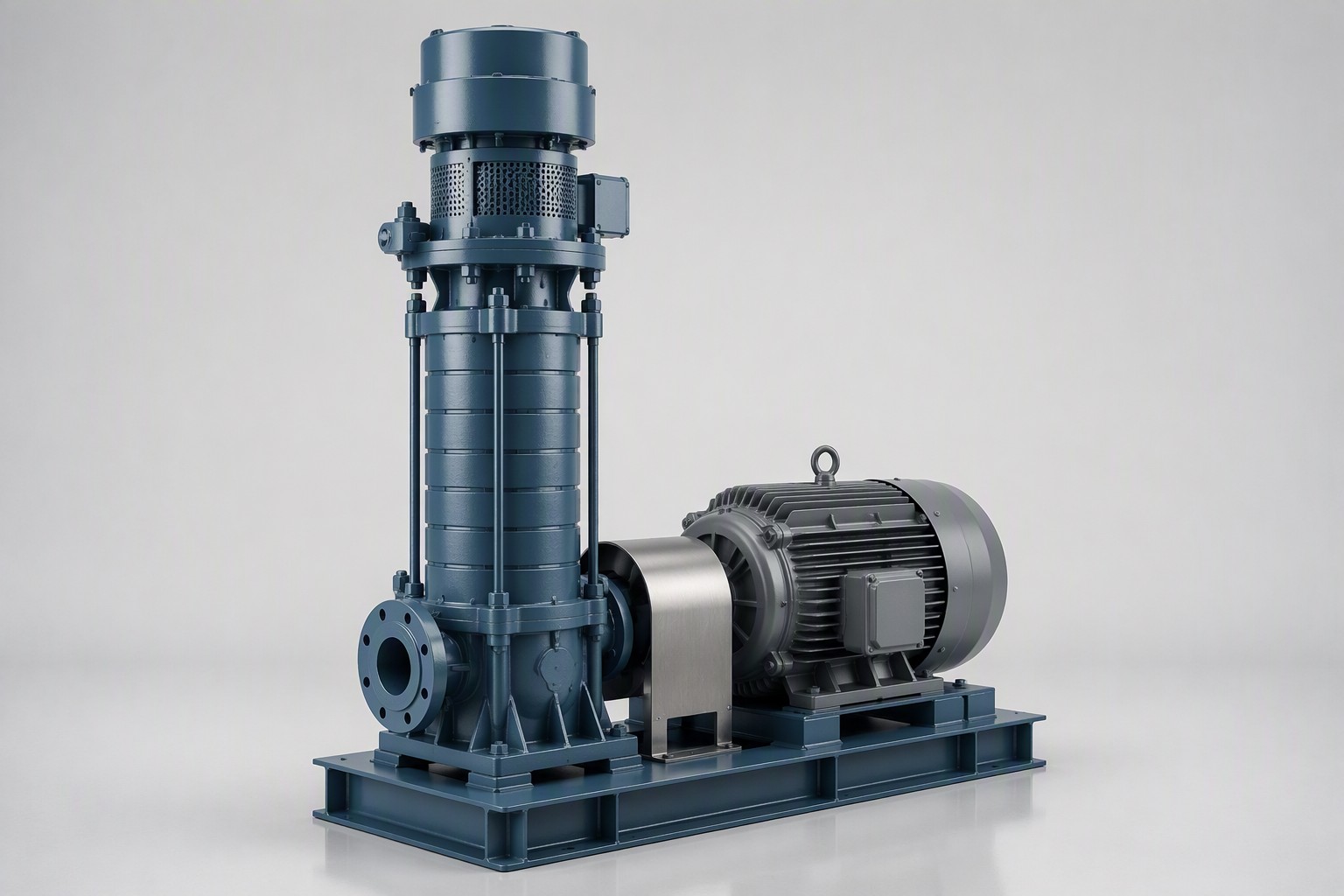
Map Every Pump Duty in the Plant First
A water treatment plant is a sequence of hydraulic steps, each with a different fluid: raw water lifted from the intake, coagulants dosed, filter feed and backwash delivered, clarified water transferred and distributed, and solids leaving as sludge. List every duty — flow range, head, temperature, chemistry, solids content — before choosing any pump, as in our overview of water treatment pump selection.
- Raw water intake — clean, cold water at variable river or well levels.
- Chemical dosing — small, accurate coagulant and disinfectant metering.
- Filter feed and backwash — larger flows at moderate head, with backwash surges.
- Transfer and distribution — steady clean-water pumping to storage and the network.
- Sludge handling — viscous, solids-laden flows to thickeners and dewatering.
Clean-Water Stages: IS/ISW End-Suction Centrifugal Pumps
The backbone of a plant is the end-suction centrifugal pump: simple, efficient on clean water and available across the full flow range. Qingdao Green Power publishes the IS/ISW series for water and low-viscosity duty at 1.5–1600 m³/h flow, 2–125 m head and up to 80 °C, with motors from 0.18 kW to 250 kW. Above roughly 150 cSt a centrifugal loses efficiency fast, so keep the family on clean-water stages — intake, settled and clarified water, filter feed. Full details are on the industrial centrifugal pump page.
Space-Saving and Higher-Head Duties: ISG/GDL Inline Pumps
Where floor space is tight or head climbs — filter feed to elevated tanks, membrane feed, distribution boosting — a vertical inline pump installs directly in the pipe run with suction and discharge flanges in line. Qingdao Green Power's ISG/GDL pipeline pump range is published at 1.6–1200 m³/h flow, 5–150 m head and -20 °C to 120 °C; the GDL multistage variant covers the higher-head band above 80 m typical of backwash and booster duties.
Below-Grade Pits, Tanks and Wet Wells: ZJL/LZ Submerged Pumps
Not every suction source sits above the pump. Intake sumps, wash-water recovery pits and sludge holding tanks are often below grade, where a surface pump would need costly deep suction piping. A submerged vertical pump puts the impeller under the liquid: the motor stays above on a flanged top plate and the shaft runs down through a bearing column, so no mechanical seal sits in the liquid. Qingdao Green Power publishes the ZJL/LZ range at 2–600 m³/h flow, 8–100 m head and 0.5–3 m immersion (customisable), standard service to 100 °C and a high-temperature version to 300 °C — see the submerged vertical pump range for pit installations.
Sludge and Biosolids: G-Type Progressive Cavity Pumps
Solids removed by sedimentation and filtration leave as sludge — viscous, abrasive and often sticky — and centrifugal pumps are the wrong tool once it thickens. Sludge lines use a positive displacement machine, typically a G-type single-screw (progressive cavity) pump whose helical metal rotor turns inside an elastomeric stator; the sealed cavities travel from suction to discharge and push the sludge steadily at low shear. Qingdao Green Power publishes the G-type range at 0.1–150 m³/h flow and 0.6–2.4 MPa, with NBR, EPDM or FKM stators matched to the sludge. One rule is absolute: never run a progressive cavity pump dry — the elastomer stator is destroyed within seconds. Our article on the industrial sludge transfer pump covers stator and sizing practice.
The Wastewater Side of the Fence
Plants that also treat effluent face the mirror-image problem: raw sewage and solids-laden streams at the inlet. Qingdao Green Power covers that side with the ZW solids-handling centrifugal pump at 5–800 m³/h flow, 14–80 m head and 2.2–55 kW, its impeller passage matched to the debris. Where the two sides meet, balance capacities so no stage becomes a bottleneck; see our review of wastewater pump solutions.
Size the Duty, Then Confirm the Model
Close every stage the same way: size each pump on its worst operating point, keep available NPSH above the pump's requirement at the highest liquid temperature, and check materials and seals against the real chemistry — wetted parts that suit raw river water may not suit a chlorinated or coagulant-laden stream. Treatment plants run continuously, so efficiency and redundancy matter as much as first cost: stage pumps in parallel for turndown, add standby where the process cannot stop, and use variable-speed drives on swinging loads. The same duty-point discipline applies in industrial pumps in power plants. Send your stage-by-stage duty data to Qingdao Green Power and confirm current model availability and specifications before procurement.
Frequently Asked Questions
Which pumps does a water treatment plant use for clean water?
Clean-water stages — raw intake, filter feed, transfer and distribution — run on end-suction centrifugal pumps. Qingdao Green Power publishes the IS/ISW range at 1.5–1600 m³/h flow, 2–125 m head and up to 80 °C (0.18–250 kW), plus the ISG/GDL vertical inline range at 1.6–1200 m³/h and 5–150 m head for higher-head or space-saving boosting.
When should a plant choose a ZJL/LZ submerged pump?
When the suction source is a below-grade pit, tank or wet well where a surface pump cannot hold flooded suction. ZJL/LZ pumps keep the impeller under the liquid and the motor above on a flanged top plate, with no mechanical seal in the liquid — published at 2–600 m³/h flow, 8–100 m head and 0.5–3 m immersion (customisable), standard service to 100 °C and a high-temperature version to 300 °C.
What kind of pump moves thick sludge in a treatment plant?
A G-type single-screw (progressive cavity) pump moves thick sludge and biosolids: a helical rotor inside an elastomeric stator forms sealed cavities that carry the sludge steadily to discharge, at 0.1–150 m³/h flow and 0.6–2.4 MPa. Never run it dry — the stator is destroyed within seconds — and match stator grade (NBR, EPDM or FKM) to the sludge chemistry.
What data should I collect before selecting water treatment plant pumps?
Flow in average and peak conditions, total head, liquid temperature and chemistry, solids content and particle size, available NPSH at each suction, and the operating philosophy — standby duty, variable-speed control and load profiles. Qingdao Green Power sizes quotations from this data set; confirm current model availability before procurement.
Send your stage-by-stage duty data — flow, head, liquid chemistry, solids content and pit layout — and the engineering team will map each treatment stage to the right pump.
Get a Quote
Send your fluid data and duty point. Engineers reply within 24 hours.
Contact Us →💬 WhatsApp NowRelated Products
- Centrifugal Pump (IS/ISW)
- ISG/GDL Pipeline Pump
- ZJL/LZ Submerged Pump
- Industrial Screw Pump
Related Articles
Water Treatment Pump Selection
Method for the whole plant
Wastewater Pump Solutions
Pumps for the effluent side
Industrial Sludge Transfer
Moving thick sludge reliably