
Industrial Water Treatment Pump Selection
Industrial water treatment pump selection explained: how to match end-suction, inline, multistage, submerged and screw pumps to raw water intake, clarification, pressure boosting, boiler feed, wastewater and sludge duties.
Industrial water treatment pump selection starts with the duty, not the pump: each stage of the treatment train — raw water intake, clarification, boosting, boiler feed, wastewater and sludge — has its own flow, head and water quality, and favours a different pump family. Clean water moves best with end-suction or inline centrifugal pumps; high-head services need multistage designs; solids-laden or below-grade streams use solids-handling or submerged pumps; thick sludge and polymer streams go to progressive cavity screw pumps.
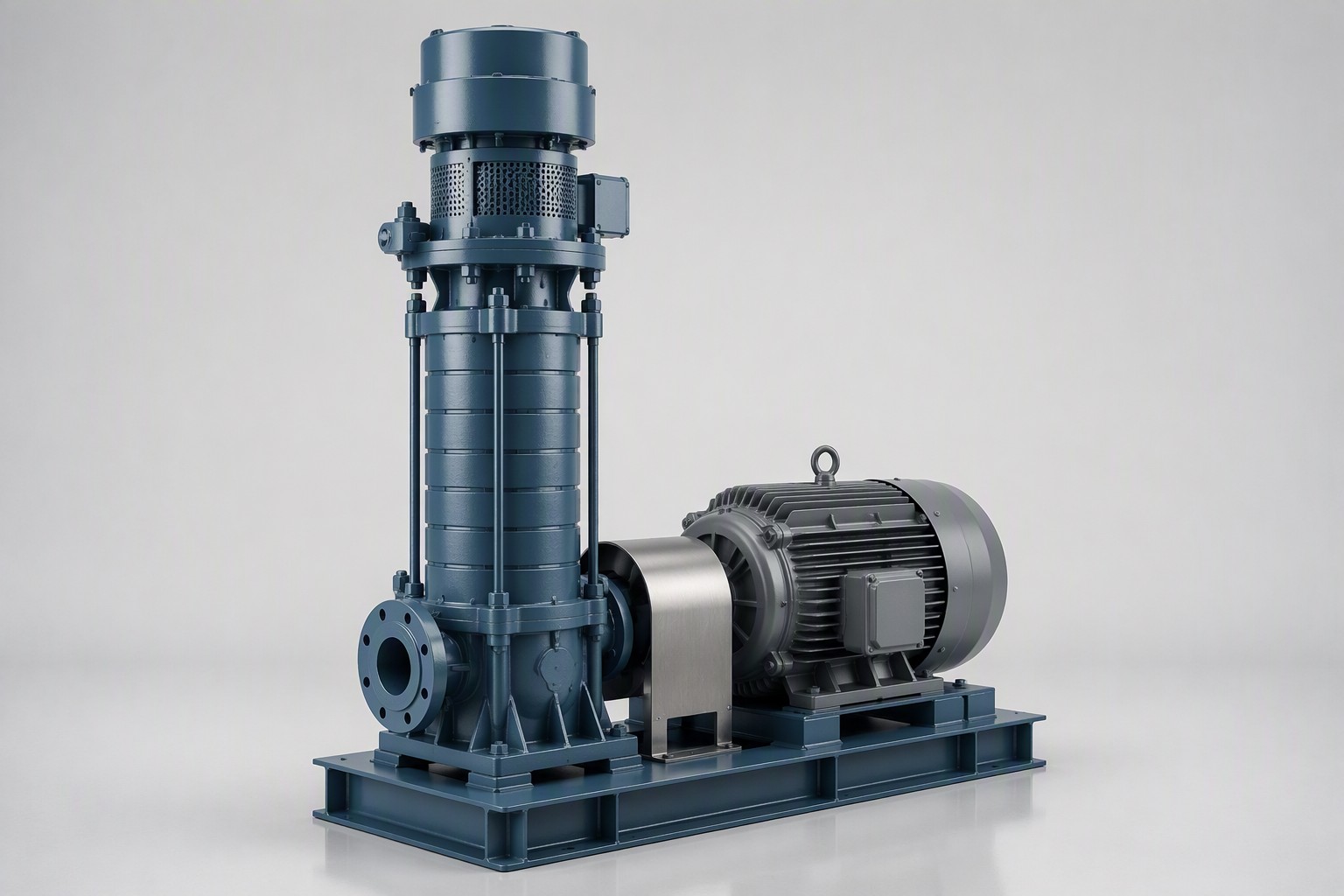
Define the Duty Before Choosing the Pump
A water treatment system is a chain of hydraulically linked stages, so a pump that is right for intake transfer can be wrong for boiler feed or for sludge lines. The selection starts with the same duty data at every stage:
- Flow rate in m³/h, including the spread between minimum and peak demand and future margin;
- Total head or discharge pressure, covering static lift, pipe friction and valve losses;
- Temperature and chemistry, which set the wetted materials and the seal type;
- Solids, fibre and grit loading, which decide whether a closed impeller is safe;
- Suction conditions — flooded or lift — and the available NPSH at the site.
Raw Water Intake and Process Transfer: IS/ISW Centrifugal Pumps
Most plant intake water is clean and low in viscosity, which is exactly the duty a centrifugal pump handles most efficiently. Qingdao Green Power's IS/ISW range, part of the industrial centrifugal pump product line, is published at 1.5–1600 m³/h flow, 2–125 m head and 0.18–250 kW, with liquid temperatures to 80°C. The IS layout is a horizontal end-suction pump on a baseplate, preferred where suction is marginal because end-suction designs generally need a lower NPSH; the ISW variant is the horizontal inline arrangement that installs compactly in the pipe run.
High-Head Boosting and Boiler Feed: ISG/GDL Pipeline Pumps
Once clarified water must be pushed to an elevated tank, across a plant network or into a boiler, a single-stage pump may not generate enough head. The ISG/GDL pipeline pump range from Qingdao Green Power, covered on the pipeline pump product page, is published at 1.6–1200 m³/h with heads to 150 m and service from -20°C to 120°C. ISG vertical inline pumps mount directly in the pipe run with suction and discharge flanges in line, saving floor space; the GDL multistage variant builds the higher heads — above 80 m — typical of boiler feed and high-rise boosting, the duties examined in our boiler feed pump applications article.
Wastewater, Wet Wells and Solids Streams: ZW and ZJL/LZ Pumps
Treatment plants also collect washdown water, filter backwash and reject streams that carry solids, which would quickly jam a closed impeller sized for clean water. For screened wastewater and solids-laden water, the ZW solids-handling centrifugal series is published at 5–800 m³/h with 14–80 m head, using passages sized to pass rags and grit. Where water collects below grade in a tank or wet well, the ZJL/LZ submerged vertical pump installs through a flanged top plate with the impeller submerged, the motor above and no mechanical seal in the water: published at 2–600 m³/h, 8–100 m head and 0.5–3 m immersion (customisable), with standard service to 100°C.
Sludge and Polymer Streams: G-Type Screw Pumps
Thick sludge and the concentrated polymer used for flocculation are too viscous for a centrifugal impeller, so they are moved by a positive displacement machine. The G-type single-screw (progressive cavity) pump uses a helical metal rotor turning inside an elastomeric stator; the two form sealed cavities that carry the medium steadily to discharge with low shear. Qingdao Green Power publishes the G range at 0.1–150 m³/h and 0.6–2.4 MPa for high-viscosity, abrasive and slurry media, with stator grades (NBR, EPDM or FKM) matched to the chemistry. One rule dominates: never run a progressive cavity pump dry — without liquid for lubrication and cooling, the elastomer stator is destroyed within seconds.
QGP Pump Families for Industrial Water Treatment Duty
| Duty stage | Recommended pump family | Published range (Qingdao Green Power) |
|---|---|---|
| Raw and process water | IS / ISW end-suction and inline centrifugal | 1.5–1600 m³/h, head 2–125 m, ≤80°C |
| Boosting and boiler feed | ISG vertical inline / GDL multistage pipeline | 1.6–1200 m³/h, head 5–150 m |
| Solids-laden wastewater | ZW solids-handling centrifugal | 5–800 m³/h, head 14–80 m |
| Below-grade tanks and wet wells | ZJL/LZ submerged vertical | 2–600 m³/h, head 8–100 m, immersion 0.5–3 m |
| Sludge and polymer | G-type screw (progressive cavity) | 0.1–150 m³/h, 0.6–2.4 MPa |
A Practical Checklist for Water Treatment Pump Selection
Keep the selection method consistent from the intake to the sludge line with these checks:
- Flow and head per stage — size each pump on its own duty, including peak demand and future margin.
- Temperature and chemistry — verify them first, then choose wetted materials and the seal arrangement.
- Suction and NPSH — a flooded, low-loss suction is the cheapest reliability upgrade; where it is impossible, consider a submerged pump.
- Impeller design — closed impellers for clean water, solids-handling passages for debris-laden streams.
- Viscosity — centrifugal pumps suit water and thin process liquids; above roughly 150 cSt, use a screw or other positive displacement pump.
- Model availability — confirm current models and specifications with Qingdao Green Power before procurement.
Send the duty data for every stage — flow, head, temperature, chemistry and solids content — and the Qingdao Green Power engineering team will map each one to the current IS/ISW, ISG/GDL, ZW, ZJL/LZ or screw-pump range.
Frequently Asked Questions
Which pump type should I choose for general raw and process water transfer in a treatment plant?
For clean, low-viscosity water, use an end-suction or inline centrifugal pump. Qingdao Green Power publishes the IS/ISW centrifugal range at 1.5–1600 m³/h flow, 2–125 m head and temperatures to 80°C: IS is the horizontal end-suction layout, while ISW is the inline version for compact installations. Above roughly 150 cSt viscosity, switch to a positive displacement pump.
How do I select a pump for a high-head boiler feed or pressure-boosting duty?
High-head water duties call for a multistage pump. Qingdao Green Power's ISG/GDL pipeline range is published at 1.6–1200 m³/h with heads to 150 m, and the GDL multistage variant targets heads above 80 m typical of boiler feed and high-rise pressure boosting; the ISG vertical inline layout mounts directly in the pipe run. Confirm the exact duty point with Qingdao Green Power before procurement.
When should I use a ZW or ZJL/LZ pump in water treatment instead of a standard centrifugal pump?
Choose the ZW solids-handling centrifugal series (published at 5–800 m³/h and 14–80 m head) when the stream carries rags, solids or grit that would jam a standard closed impeller, and the ZJL/LZ submerged vertical series (2–600 m³/h, 8–100 m head, 0.5–3 m immersion) when water must be lifted from a below-grade tank or wet well where surface suction is impossible and no shaft seal should sit in the liquid.
Why would a screw pump be used in a water treatment plant?
Thick sludge, polymer solutions and other viscous or shear-sensitive streams need a positive displacement pump. The G-type single-screw (progressive cavity) pump, published at 0.1–150 m³/h and 0.6–2.4 MPa, moves such media steadily with low shear, but it must never run dry because the elastomer stator is destroyed within seconds without liquid lubrication.
Send the duty data for each stage — flow, head, temperature, water chemistry and solids content — and the engineering team will map your plant to the right pump families.
Get a Quote
Send your fluid data and duty point. Engineers reply within 24 hours.
Contact Us →💬 WhatsApp NowRelated Products
- IS/ISW Centrifugal Pump
- ISG/GDL Pipeline Pump
- ZJL/LZ Submerged Pump
Related Articles
Water Treatment Plant Pump Selection
Whole-site sizing method
Wastewater Pump Solutions
Stage-by-stage guidance
Boiler Feed Pump Applications
High-head feed duties