
Pumping Thick Liquids: Common Problems and Solutions
Pumping thick liquids, explained: why high-viscosity media cause suction starvation, cavitation, overload and lost flow in pumps — and the practical screw and gear pump solutions that fix them.
Thick liquids should be moved by positive displacement pumps because each revolution displaces a fixed volume, so flow does not collapse as viscosity or pressure rises; the classic failures — suction starvation, cavitation, overload and falling output — are almost always technology or suction-side mismatches. Qingdao Green Power publishes its G-type single screw (progressive cavity) pump at 0.1–150 m³/h and 0.6–2.4 MPa for high-viscosity media, and its IS/ISW centrifugal guidance tells users to change to a gear or screw pump above about 150 cSt.
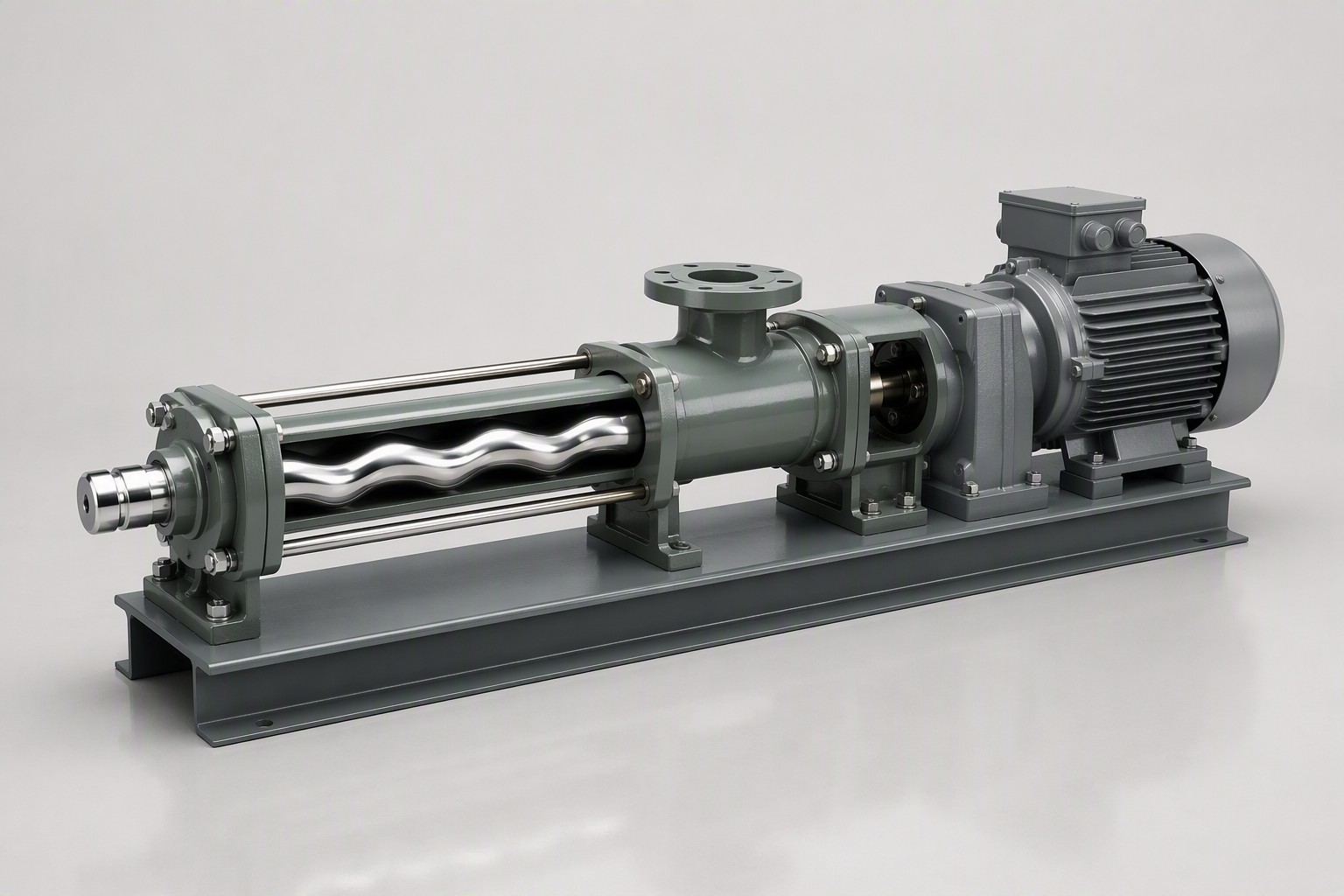
Why Thick Liquids Are Difficult to Pump
Viscosity is a liquid's internal resistance to flow, quoted in centistokes (cSt). Water is close to 1 cSt, while heavy fuel oils, resins, molasses, food pastes and bitumen can reach thousands or even millions of centistokes. The thicker the liquid, the more energy it absorbs in every pipe and every pump passage — which is why problems appear first in long suction lines, cold starts and undersized machines.
In a centrifugal pump the impeller throws liquid outward using velocity energy, and a thick liquid resists that acceleration: head and flow fall, efficiency drops, and the pump can appear to run while delivering almost nothing. In a positive displacement (PD) pump, flow is set by the trapped volume per revolution, and a thick liquid — which seals internal clearances better than a thin one — actually holds volumetric efficiency. Most common problems are therefore symptoms of using the wrong pump family or ignoring how viscosity changes at cold start; the systematic process is set out in our high-viscosity pump selection guide.
The Most Common Problems When Pumping Thick Liquids
1. Suction starvation and cavitation
A pump can push only what it is fed. Thick liquid moves slowly into the inlet, friction in the suction line lowers the local pressure, and dissolved gas or vapour flashes out of the liquid. The result is the classic noisy, vibrating pump with fluctuating or zero flow, and often rapid damage to the impeller or casing. The fix is to keep the suction run short, large in diameter and flooded, and to heat the fluid so it feeds the pump readily.
2. Performance collapse in a centrifugal pump
As viscosity climbs past the design point, friction inside the impeller steals head and flow while shaft power can climb at the same time. Qingdao Green Power's published guidance for its IS/ISW centrifugal pump range is to switch to a gear or screw pump above about 150 cSt; below that level these pumps deliver efficient, non-pulsating flow for water-like process liquids.
3. Cold-start overload and slow start-up
Most thick liquids are specified at operating temperature but stored cold, where they are far more viscous. A pump sized only for the warm duty can stall, trip the motor or shear a coupling on a cold start because the starting torque demand is much higher. Size for the worst-case viscosity — usually the coldest credible temperature — and heat the tank outlet or the line where practical.
4. Wear, shear damage and dry running
Abrasive solids in thick media accelerate wear in any pump with tight clearances, while shear-sensitive products such as emulsions, polymers and food pastes can be damaged by aggressive impellers or meshing rotors. Elastomeric components add another risk: if the pump loses suction, a progressive cavity stator can be destroyed within seconds of dry running, so protection devices matter as much as the pump itself.
Common Thick-Liquid Pumping Problems at a Glance
| Problem | Typical symptom | Engineering fix |
|---|---|---|
| Suction starvation and cavitation | Noisy operation, fluctuating or zero flow | Short, large-bore, flooded suction; heat the fluid |
| Centrifugal performance loss | Head and flow fall as viscosity rises | Above about 150 cSt switch to a gear or screw pump |
| Cold-start overload | Motor trip or slow start at low temperature | Size for coldest viscosity; pre-heat tank outlet or line |
| Dry run of an elastomeric stator | Stator destroyed within seconds | Fit low-level and dry-run protection |
Practical Solutions for Thick-Liquid Duties
Whatever the medium, the same engineering responses solve most thick-liquid pumping problems:
- Match the technology to the viscosity: positive displacement pumps for thick media, centrifugal pumps only for thin process liquids.
- Heat where it helps: tank coils, jacketed lines and insulation lower viscosity at the pump inlet and cut friction losses.
- Design the suction side first: keep it short, straight, large-bore and flooded to avoid starvation and cavitation.
- Fit protection: relief valves guard against a blocked discharge; low-level switches and dry-run trips protect elastomeric stators.
- Use speed control: a variable-speed drive lets a PD pump match flow to demand without pressure spikes.
Which Pump Solves Each Problem
For genuinely thick, shear-sensitive or abrasive media, the G-type single screw (progressive cavity) pump is the workhorse. A helical metal rotor turns inside an elastomeric stator, forming sealed cavities that carry the product from suction to discharge with low shear. Qingdao Green Power publishes the G-type at 0.1–150 m³/h and 0.6–2.4 MPa for high-viscosity oils and resins above about 1500 cSt, sludge, slurry, bitumen, food pastes and shear-sensitive polymers; the full family is shown on the G and 3GB industrial screw pump product page.
Where the liquid is a clean oil that is hot — and therefore thin — the 3GB triple screw pump is the answer, conveying fluid axially through three intermeshing screws at 2.4–241.7 m³/h up to 350°C. Heated fuel, crude and asphaltic duties are discussed in our heavy oil pump selection guidance.
For clean oils at moderate viscosity a gear pump is often the compact, economical choice, and rotary lobe pumps suit very thick, gentle-handling products; for these, confirm current model availability and specifications with Qingdao Green Power. Where the medium is thin — below about 150 cSt — the IS/ISW centrifugal range remains the efficient, non-pulsating option, and a wider comparison of technologies appears in our article on the best pump for high-viscosity liquids.
Frequently Asked Questions
Why does a centrifugal pump struggle to pump thick liquids?
A centrifugal pump converts impeller velocity into pressure, and friction inside a thick liquid makes head, flow and efficiency fall quickly. Qingdao Green Power's published guidance for its IS/ISW centrifugal pumps is to switch to a gear or screw pump when viscosity rises above about 150 cSt.
What causes cavitation and starvation when pumping thick liquids?
Thick liquid feeds the pump slowly, so the inlet starves and local pressure can fall until vapour or dissolved gas flashes out — the classic symptoms are noise, vibration, fluctuating flow and internal damage. Keep the suction line short, large-bore and flooded, and heat the fluid so it reaches the inlet readily.
Which Qingdao Green Power pump handles very thick, shear-sensitive media?
The G-type single screw (progressive cavity) pump is published at 0.1–150 m³/h and 0.6–2.4 MPa for high-viscosity oils and resins above about 1500 cSt, sludge, slurry, bitumen, food pastes and shear-sensitive polymers. A helical rotor turns inside an elastomeric stator, so the product moves through gentle sealed cavities and the pump must never run dry.
How do I prevent dry-run damage when pumping thick liquids?
The elastomeric stator of a progressive cavity pump is destroyed within seconds if the pump runs dry. Fit low-level protection or a dry-run trip on the supply tank and line, and confirm the protection scheme and stator grade for the selected model with Qingdao Green Power.
Tell us your liquid, its viscosity at cold and operating temperature, and the flow and pressure you need — the engineering team will identify the cause of the problem and the pump that solves it.
Get a Quote
Send your fluid data and duty point. Engineers reply within 24 hours.
Contact Us →💬 WhatsApp NowRelated Products
- Industrial Screw Pump (G / 3GB)
- Centrifugal Pump
Related Articles
Best Pump for High-Viscosity Liquids
PD options for thick fluids
High-Viscosity Oil Transfer Pump
Hot and heavy oil duties
Bitumen and Asphalt Transfer Pump
Heated asphaltic media