
Industrial Pumps for Power Plants
Industrial pumps for power plants explained: how boiler feed, condensate, cooling-water, submerged pit, wastewater and sludge pumps divide the duty in a thermal station — and which Qingdao Green Power range fits each service.
A power plant is one system made of many pumping duties: multistage boiler feed pumps push deaerated feedwater into the boiler at high head, large-flow centrifugal pumps move condensate and cooling water, and dedicated pumps handle fuel, wastewater, sludge and heat-transfer fluid. Qingdao Green Power maps the plant with the ISG/GDL pipeline range on boiler feed duty, ZJL/LZ submerged pumps in pits and hot-water sumps, ZW wastewater and G-type screw pumps on effluent and sludge, and the RY series on thermal-oil circuits.
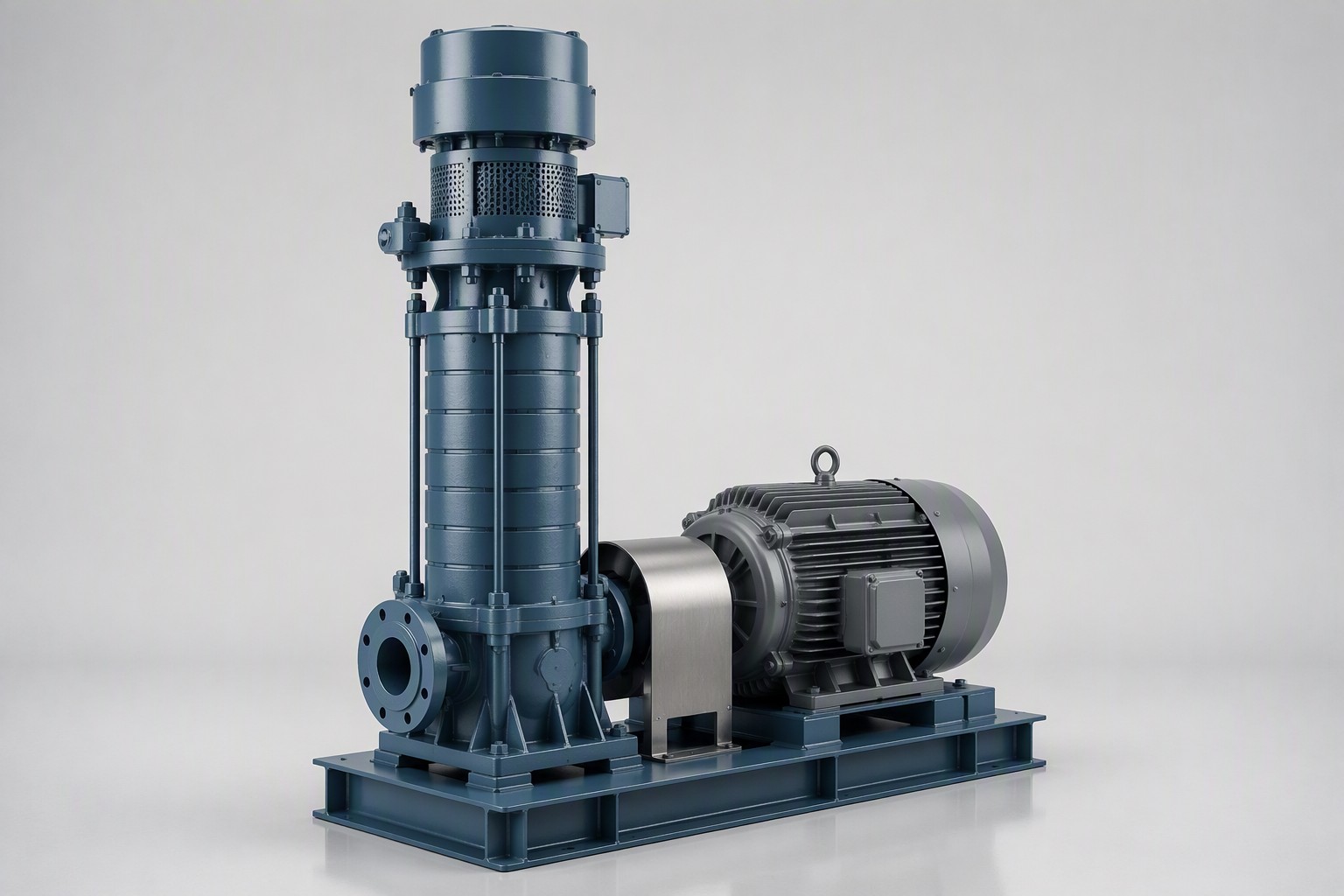
Where Pumps Work in a Power Plant
A thermal power station turns heat from coal, gas, biomass or waste heat into steam and electricity, and almost every auxiliary system around that steam cycle is a pumping duty. Each service group sets its own flow, head, temperature and reliability rules:
- Boiler feedwater and condensate — hot water at high head, continuous duty, the most critical machines on site.
- Cooling water and general service — very large flows at modest head, running almost permanently.
- Pits, sumps and hot-water tanks — liquids below floor level that need a submerged pump.
- Wastewater, effluent and sludge — drains and sewage with solids, plus thick abrasive sludge.
- Fuel oil and thermal oil — tank transfer and heat-transfer-fluid circulation in auxiliary loops.
Boiler Feedwater — the Critical High-Head Duty
The boiler feed pump sits between the deaerator and the boiler and is the machine the plant cannot run without. It delivers hot, deaerated feedwater above boiler operating pressure, runs continuously and follows steam demand, so it is normally installed with standby and minimum-flow protection. Boiler pressure converts into high total head, so the standard configuration is a multistage centrifugal pump — from small captive sets to large utility boilers, as covered in our review of boiler feed pump applications and the guide to thermal power plant pumps.
Qingdao Green Power covers this band of duty with the GDL multistage variant of its vertical inline ISG/GDL pipeline pump range, which mounts directly in the pipe run to save floor space. The published envelope:
Published ISG/GDL Pipeline Pump Envelope
| Parameter | Value |
|---|---|
| Flow rate (ISG series) | 1.6–1200 m³/h |
| Head | 5–150 m |
| Motor power | 0.18–132 kW |
| Liquid temperature | -20°C to 120°C |
| Installation | Vertical inline — motor above, in-line flanges |
| GDL multistage variant | Higher-head band above 80 m — boiler feed, high-rise boost |
Confirm the boiler's maximum continuous rating, discharge pressure, deaerator elevation and feedwater temperature against the selected pump curve.
Condensate, Cooling Water and General Service
Away from the feedwater train, flows are large and heads are modest. Condensate extraction, circulating-water, cooling-tower and general transfer duties are classic centrifugal territory, where pumps must hold efficiency over long running hours. Qingdao Green Power's centrifugal pump family covers this service class, and an end-suction layout with lower NPSH requirement is worth comparing when suction conditions are tight.
Submerged Pumps for Pits, Sumps and Hot Water
Condensate pits, drain sumps, cooling-tower basins and hot-water tanks sit below the pump floor, where a surface pump would struggle for suction. ZJL/LZ submerged vertical pumps install through a flanged top plate with the impeller submerged and the motor above, and no mechanical seal operates in the pumped medium. The published range covers 2–600 m³/h flow, 8–100 m head and 0.5–3 m immersion (customisable); standard models serve liquids to 100°C and the high-temperature version reaches 300°C for hot-water pits and tank transfer.
Wastewater, Sludge and Auxiliary Fluid Systems
Around the turbine hall and the water-treatment area, the plant also produces drains, sewage, effluent and sludge that must be lifted and transferred. Solids-handling ZW wastewater pumps (5–800 m³/h, 14–80 m head, 2.2–55 kW) move drains and solids-laden wastewater, while G-type single-screw progressive cavity pumps transfer sludge at 0.1–150 m³/h and 0.6–2.4 MPa. Both services are covered in our wastewater pump solutions and industrial sludge transfer guides.
Self-priming centrifugal pumps lift fuel and oil from storage, and RY thermal-oil pumps — rated -20°C to 350°C at 1–500 m³/h and 1–12.5 bar — circulate heat-transfer fluid in auxiliary heating loops. Confirm current fuel and thermal-oil configurations with Qingdao Green Power for your plant duty.
Selection Checks for Power Plant Pumps
Reliability in station service is won in the application engineering. Across all the duties above, the same checks keep pumps healthy between overhauls:
- Run at the duty point — continuously running machines must stay near their best-efficiency point; oversized selections drift and overheat.
- Respect NPSH and suction layout — hot deaerator feedwater is close to vapour pressure, so keep suction piping short and give pit duties a submerged pump instead of a suction lift.
- Provide redundancy where it matters — boiler feed pumps need duty and standby machines with reliable changeover logic.
- Protect low flow — a functional minimum-flow recirculation line prevents overheating and vapour binding at low load.
- Match materials and temperature rating — confirm casing, impeller, seal and gasket grades against water chemistry, and choose the high-temperature version above 100°C.
- Monitor continuously — log vibration, bearing temperature and seal leakage so wear is caught early.
Frequently Asked Questions
Which industrial pumps are used in a power plant?
A plant's pump map covers boiler feedwater and condensate with ISG/GDL pipeline pumps (the multistage GDL variant on feed duty), large-flow centrifugal pumps for cooling water and general service, ZJL/LZ submerged pumps for pits and hot-water sumps, and ZW wastewater plus G-type screw pumps for effluent and sludge. Fuel-oil and thermal-oil circuits use self-priming centrifugal and RY thermal-oil pumps.
Why is the boiler feed pump the most critical pump in a plant?
Feedwater flow keeps boiler water level stable, and if it stops the boiler must trip or risk serious damage. The feed pump is therefore a continuously running, high-head machine with standby provision, minimum-flow recirculation protection and close monitoring — a trip here stops the whole station.
Which Qingdao Green Power pump handles boiler feedwater duty?
The GDL multistage variant of the ISG/GDL vertical inline pipeline range. The published envelope is 1.6–1200 m³/h flow, 5–150 m head, 0.18–132 kW power and -20°C to 120°C, with the multistage GDL configuration targeting the higher-head band above 80 m used for boiler feed and high-rise boosting.
Which Qingdao Green Power pumps move wastewater and sludge at a plant?
ZW wastewater centrifugal pumps, published at 5–800 m³/h flow, 14–80 m head and 2.2–55 kW, handle drains and solids-laden wastewater, while G-type single-screw pumps transfer sludge at 0.1–150 m³/h and 0.6–2.4 MPa. For below-grade pits, ZJL/LZ submerged pumps serve standard duty to 100°C and a high-temperature version to 300°C.
Send your plant system list — boiler rating, cooling-water duty, pit depths and effluent flows — and the engineering team will map each service to the right ISG/GDL, ZJL/LZ, ZW or G configuration.
Related Products
- ISG/GDL Pipeline Pump
- Centrifugal Pump
Related Articles
Boiler Feed Pump Applications
Feedwater duties across steam plants
Thermal Power Plant Pumps
Station-wide pump review
Wastewater Pump Solutions
Effluent and sludge handling