
Industrial Pump FAQ Guide
Straight answers to the most common industrial pump questions: centrifugal vs positive displacement, the duty data a supplier needs, viscosity and temperature limits, suction and sealing basics, and special application guidance.
An industrial pump must be matched to the liquid it moves: flow rate, head, viscosity and chemistry decide whether the right machine is a centrifugal pump or a positive displacement pump such as a gear or screw pump. This FAQ guide answers the questions buyers ask most often before specifying a pump — from sizing and viscosity limits to suction, sealing and special applications such as chemical, food, heavy-oil and vacuum duties.
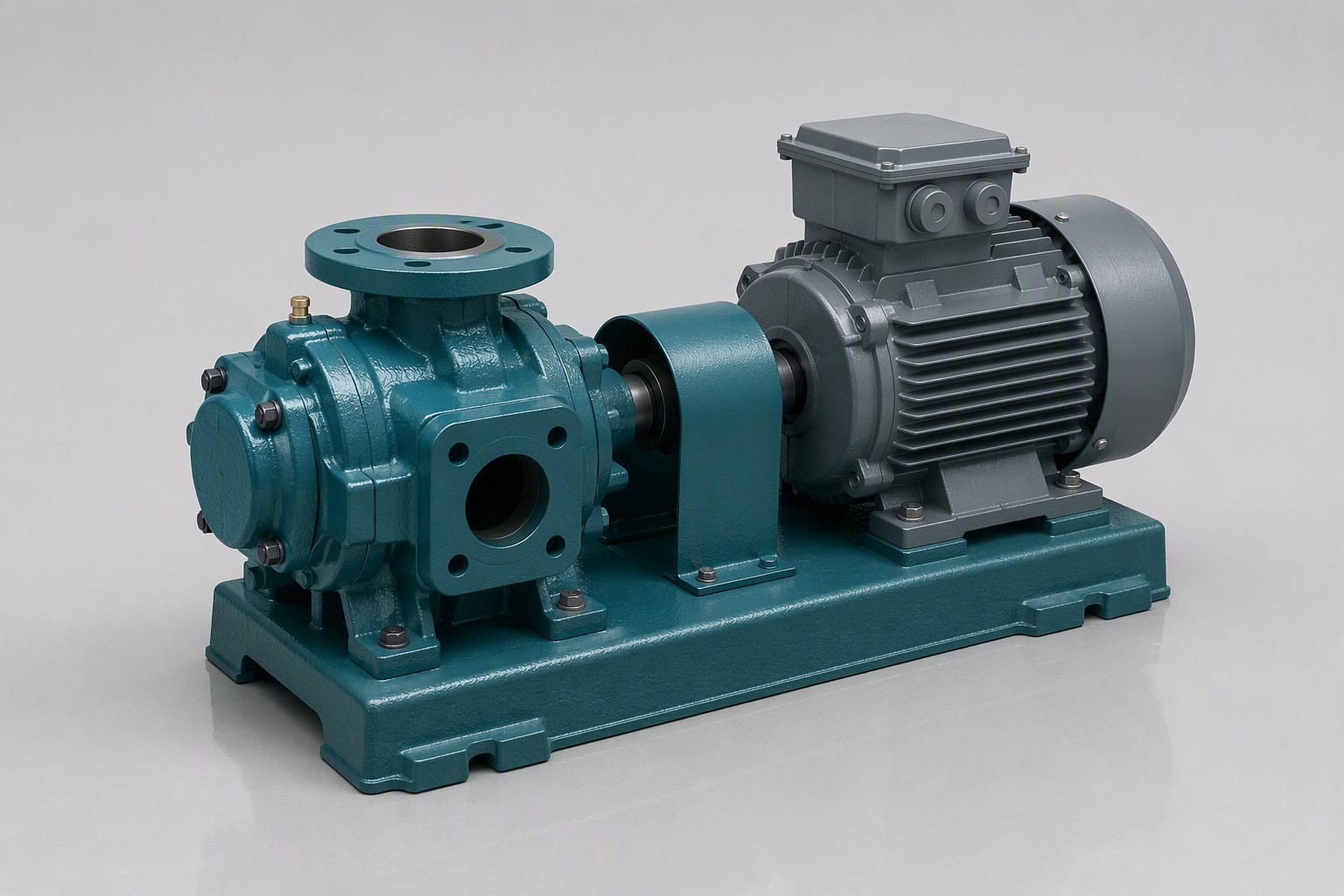
Centrifugal or Positive Displacement: Which Do You Need?
Almost every industrial pump question comes back to one decision: does the duty need a centrifugal or a positive displacement (PD) machine? A centrifugal pump spins an impeller that accelerates the liquid and converts the velocity into pressure, delivering continuous, non-pulsating flow that suits water and thin process liquids. A positive displacement pump traps a fixed volume of liquid and forces it out on every cycle, so flow stays steady when discharge pressure changes — which is why PD machines dominate viscous, high-pressure and metering duties.
Within the PD family, gear pumps are the workhorses for clean oils and fuels: two meshing gears trap liquid between the teeth and the casing and carry it from suction to discharge in a compact, economical package. Screw pumps extend the same idea to higher viscosities, slurries and shear-sensitive media. When the fluid is a heavy oil or viscous petroleum product, a gear-type transfer pump is normally the first machine to evaluate — see our heavy oil transfer pump article — while abrasive service points to the screw pump family.
What Duty Data Do Suppliers Need for a Quotation?
A pump can only be sized from data, so the quotation is only as good as the duty description. Collect the full operating envelope, not just the normal running point, before contacting a supplier:
- Flow rate (m³/h): average and peak values.
- Total head or discharge pressure, including static lift and pipe friction.
- Liquid name and temperature, specific gravity and viscosity.
- Available NPSH at the pump suction.
- Solids, abrasives or shear-sensitive behaviour of the medium.
- Installation layout, motor voltage and enclosure class.
A supplier that receives this set can shortlist the correct pump family and flag risks — suction problems, viscosity limits or material incompatibility — before you order, rather than after installation.
How Do Viscosity and Temperature Change the Answer?
Viscosity is the property that most often moves a duty from one pump family to another. A centrifugal pump performs economically on water-like liquids: Qingdao Green Power publishes its IS/ISW industrial centrifugal pump range at 1.5–1600 m³/h flow, 2–125 m head and liquid temperatures up to 80 °C. As viscosity rises above roughly 150 cSt, friction losses grow quickly, flow and efficiency fall and shaft power climbs — the crossover where most engineers switch to a positive displacement pump.
Temperature acts through materials, seals and cooling. Standard water-duty machines are rated to about 80–120 °C depending on the series, while heat-transfer-oil systems need dedicated high-temperature machines: Qingdao Green Power's RY thermal-oil circulation pump is published at 1–500 m³/h for heat transfer fluid from -20 °C to 350 °C with natural air-cooling fins instead of a cooling-water supply. Confirm seal and elastomer ratings as well as casing material for every degree of temperature.
What About Special Liquids and Special Duties?
Some questions are about the liquid itself. Hygienic food, dairy and beverage products require stainless wetted parts, low shear and cleanability — the logic is in our food-grade pump selection guide. Corrosive chemicals push the decision toward wetted materials before any performance calculation: stainless steel for mild chemicals, fluoroplastic linings for strong acids and oxidisers. LPG transfer follows entirely different sealing and safety practice.
Vacuum is a different question again: instead of moving liquid, the machine removes gas. A liquid ring vacuum pump handles wet gas streams and condensable vapours that would damage dry-running machines — Qingdao Green Power publishes the 2BV vacuum pump range at 0.45–8.33 m³/min with an ultimate vacuum of 0.097 MPa absolute.
Suction, Seals and Running Rules: Where Pump Problems Come From
Many frequent pump questions concern failure modes rather than machines. Cavitation occurs when available NPSH falls below the pump's requirement and vapour bubbles collapse against the impeller — usually from undersized suction pipework, excessive lift or warm liquid. Seals fail when starved of liquid or exposed to a fluid they were not rated for, and a positive displacement pump can overpressure a closed discharge line if no relief valve protects the discharge.
- Keep available NPSH above the pump's requirement at the operating point.
- Match the mechanical seal or gland packing to the liquid, temperature and pressure.
- Never run a single-screw (progressive cavity) pump dry — the elastomeric stator can be destroyed within seconds.
- Fit a relief valve or pressure protection on every positive displacement discharge.
If a new pump fails soon after start-up, the cause is usually upstream of the machine — incomplete duty data, poor suction piping or an incompatible seal.
Frequently Asked Questions
How do I choose between a centrifugal pump and a positive displacement pump?
Start from the liquid and the duty, not the machine. Centrifugal pumps suit water and thin, low-viscosity liquids that need continuous, non-pulsating flow — Qingdao Green Power publishes its IS/ISW centrifugal range at 1.5–1600 m³/h flow, 2–125 m head and temperatures up to 80 °C. Above roughly 150 cSt, or when flow must stay steady against changing discharge pressure, a positive displacement pump such as a gear or screw pump is the better choice.
What information should I prepare before requesting an industrial pump quotation?
The essentials are flow rate in m³/h, total head or discharge pressure, liquid name and temperature, specific gravity and viscosity, available NPSH, solids content and the installation layout. Complete duty data lets the supplier shortlist the correct pump family and flag risks such as suction problems or material incompatibility before you order.
When should a screw pump be used instead of a centrifugal pump?
Choose a screw pump for high-viscosity media, slurries, shear-sensitive products and abrasive-laden liquids. Qingdao Green Power publishes its G-type single-screw pump at 0.1–150 m³/h and 0.6–2.4 MPa for such duties, and the 3GB triple-screw pump for low-viscosity oil at temperatures up to 350 °C. Never run a single-screw pump dry — the elastomeric stator can be destroyed within seconds.
Does Qingdao Green Power support special applications such as chemical, food and vacuum duties?
Yes. Qingdao Green Power's engineering team selects from a published range that includes IS/ISW centrifugal pumps, IH stainless and IHF fluoroplastic-lined chemical pumps, G and 3GB screw pumps, RY thermal-oil circulation pumps and 2BV liquid-ring vacuum pumps. Confirm current model availability and specifications with Qingdao Green Power before procurement.
Describe your liquid — viscosity, temperature, flow and pressure — and the engineering team will recommend the pump technology and configuration that fits your duty.
Get a Quote
Send your fluid data and duty point. Engineers reply within 24 hours.
Contact Us →💬 WhatsApp NowRelated Products
- IS/ISW Centrifugal Pump
- G & 3GB Screw Pump
- 2BV Vacuum Pump
Related Articles
Chemical Process Pump Selection
Match materials to media
Boiler Feed Pump Selection Guide
High-head feed water duty
2BV Liquid Ring Vacuum Pump Selection
Wet vacuum applications